14 The Black-Litterman model and active portfolio management
14.1 Introduction
Three questions motivate this chapter. First, why does standard mean-variance optimization so often produce extreme and unstable portfolio weights in practice, and what structural remedy does the Black-Litterman model offer? Second, how should an investor who holds both a market-derived prior over expected returns and her own subjective views about specific securities or portfolios combine those two sources of information in a formally coherent way? Third, what is the relationship between the investor’s confidence in a view and the magnitude of the resulting deviation from the market portfolio, and how can that relationship be made precise and controllable? These questions sit at the intersection of Bayesian statistics, mean-variance optimization, and the practical challenge of translating investment research into disciplined portfolio positions.
The first question matters because the failure mode of unconstrained mean-variance optimization is well documented and severe. Small perturbations in estimated expected returns — well within the range of estimation error — can produce wildly different optimal weights, including large short positions and extreme concentrations that no sensible investor would hold. The root cause is that the optimizer treats point estimates of expected returns as if they were known with certainty, fully exploiting any differences between them. The Black-Litterman model corrects this by treating expected returns themselves as random variables with a prior distribution, rather than as fixed parameters. The natural choice of prior is the set of expected returns that, when plugged into the mean-variance first-order conditions, produce the observed market capitalization weights as the optimal portfolio. This “reverse-engineered” equilibrium prior anchors the optimization and prevents it from over-fitting to noisy return estimates.
The second question — about combining the market prior with subjective views — is where Bayesian statistics enters. Each view takes the form of a belief about the expected return on a specific portfolio of assets, expressed as a linear combination of individual asset returns. The investor also specifies her uncertainty about each view through a variance parameter. Given these inputs, the standard formula for the conditional distribution of a jointly normal random vector delivers a closed-form posterior distribution over expected returns that blends the equilibrium prior and the investor’s views in proportion to their relative precision. Assets about which the investor has no views are unaffected by the updating, ensuring that the model’s output is conservative wherever research coverage is absent.
The third question — about the connection between conviction and position size — is answered by examining how the posterior expected returns feed back into the mean-variance first-order conditions. Portfolio weights that result from the Black-Litterman posterior deviate from market weights in a direction and by an amount that is mathematically tied to the precision of the investor’s views: a view held with high confidence (low variance) pulls the weights more strongly toward the implied position, while a low-confidence view (high variance) produces only a modest tilt. This feature gives portfolio managers an interpretable, principled dial for scaling positions to match their actual degree of conviction. The chapter develops the full machinery — conditional normal distributions, equilibrium return extraction, Bayesian updating, and portfolio construction — and then applies it to a universe of U.S. sector exchange-traded funds to illustrate how the model functions with real data.
Black–Litterman was built for investors who effectively own the whole market and must decide how far to lean away from it. Norway’s sovereign wealth fund — the world’s largest, at roughly $2 trillion — earned a record return in 2025, driven by its huge stakes in technology names like Nvidia, Apple, and Microsoft. A fund that big starts from the market portfolio and tilts only where it has a view; turning those views into portfolio weights is exactly what this chapter formalizes. Read it at CNBC.
14.2 Conditional Normal Distributions
Consider a random vector
\[\begin{aligned} \left( \begin{array}{c} x \\ y \end{array} \right) \sim N \left( \left( \begin{array}{c} \mu \\ Q \end{array} \right), \left( \begin{array}{cc} \Sigma_{x} & \Sigma_{x y} \\ \Sigma_{xy} & \Sigma_{y} \end{array} \right) \right) \end{aligned}\]
In this setting, the conditional distribution of \(x\) given \(y\) is
\[x \mid y \sim N\left(\mu + \Sigma_{xy} \Sigma_{y}^{-1} (y - Q), \Sigma_{x} - \Sigma_{xy} \Sigma_{y}^{-1} \Sigma_{xy}\right)\]
14.3 Preferences
We start with traditional preferences given by the utility function
\[U = E(r_{p}) - \frac{1}{2} A \sigma_{p}^2\]
where \(r_{p}\) is the return on the portfolio, \(E(r_{p})\) is the expected return, \(\sigma_{p}^2\) is the variance of the return, and \(A\) is the risk aversion coefficient. Given portfolio weights \(\theta\), the optimal portfolio weights are given by the first order condition
\[\mu = A\Sigma \theta\]
Assume that there are \(n\) assets in the market.
14.4 Non-consensus beliefs about expected returns
Suppose that instead of having fixed beliefs about the distribution of returns, the investor believes that the return vector is distributed
\[r \sim N(\mu, \Sigma)\]
but that the expected returns of the assets are given by the random process \(\mu = \Pi + \epsilon^{e}\), where \(\epsilon^{e}\) is distributed normally with zero mean and covariance \(\tau \Sigma\).
Imagine that the investor has collected some information about stocks \(i\) and \(j\) and believes that taking an equal long-short position in \(i\) and \(j\) would lead to a portfolio that has mean \(q\) and standard deviation \(\omega\). Define the vector \(p = (\cdots 1 \cdots -1 \cdots)\) to represent a position of 1 in stock \(i\) and -1 in stock \(j\). The expected return of this portfolio is \(p \mu = q + \epsilon^{v}\) where \(\epsilon^{v}\) is a random variable that is normally distributed with mean 0 and variance \(\omega^{2}\). Let's assume that \(\epsilon^{v}\) is independent of \(\epsilon^{e}\). We interpret this view as conveying information on the expected means of asset payoffs so we try to calculate the value of \(E[r|p\mu = q + \epsilon^{v}]\). This setup implies that the distribution of \(\mu\) conditional on this view is
\[\mu|q + \epsilon^{v} \sim N \left(\left[(\tau \Sigma)^{-1} + p'\frac{1}{\omega^{2}}p\right]^{-1}\left[(\tau\Sigma)^{-1}\Pi + p'\frac{1}{\omega^{2}}q\right],\left[(\tau \Sigma)^{-1} + p'\frac{1}{\omega^{2}}p \right]^{-1} \right).\]
See the appendix of Satchell and Scowcroft (2007)1 for a derivation of this result.
More generally, if the investor has \(m\) views that can be represented by the \(m \times n\) matrix \(P\). The expected return of the portfolio is \(P \mu = Q + \epsilon^{v}\) where \(\epsilon^{v}\) is a random variable that is normally distributed with mean 0 and diagonal covariance matrix \(\Omega\). Let's assume that \(\epsilon^{v}\) is independent of \(\epsilon^{e}\). The distribution of \(\mu\) conditional on these views is
\[\mu|Q + \epsilon^{v} \sim N \left(\left[(\tau \Sigma)^{-1} + P'\Omega^{-1}P\right]^{-1}\left[(\tau\Sigma)^{-1}\Pi + P'\Omega^{-1}Q\right],\left[(\tau \Sigma)^{-1} + P'\Omega^{-1}P \right]^{-1} \right).\]
14.5 Applying the Black-Litterman model
Let's collect data on returns to several industry sectors in the U.S. market. To do this, we consider several sector exchange traded funds.
| .. | XLB | XLC | XLE | XLF | XLI | XLK | XLP | XLRE | XLU | XLV | XLY |
|---|---|---|---|---|---|---|---|---|---|---|---|
| count | 192.000 | 66.000 | 192.000 | 192.000 | 192.000 | 192.000 | 192.000 | 98.000 | 192.000 | 192.000 | 192.000 |
| mean |
|
|
|
|
|
|
|
|
|
|
|
| std |
|
|
|
|
|
|
|
|
|
|
|
| min |
|
-0.141 |
|
|
|
|
|
-0.152 |
|
|
|
| 25% |
|
-0.028 |
|
|
|
|
|
-0.023 |
|
|
|
| 50% |
|
|
|
|
|
|
|
|
|
|
|
| 75% |
|
|
|
|
|
|
|
|
|
|
|
| max |
|
|
|
|
|
|
|
|
|
|
|
The covariance matrix of the returns is
| TICKER | XLB | XLC | XLE | XLF | XLI | XLK | XLP | XLRE | XLU | XLV | XLY |
|---|---|---|---|---|---|---|---|---|---|---|---|
| XLB | 0.004 | 0.003 | 0.003 | 0.003 | 0.003 | 0.003 | 0.001 |
|
0.001 | 0.002 | 0.003 |
| XLC | 0.003 | 0.004 | 0.003 | 0.003 | 0.003 | 0.003 | 0.001 |
|
0.001 | 0.002 | 0.004 |
| XLE | 0.003 | 0.003 | 0.006 | 0.003 | 0.003 | 0.002 | 0.001 |
|
0.001 | 0.002 | 0.003 |
| XLF | 0.003 | 0.003 | 0.003 | 0.005 | 0.003 | 0.003 | 0.002 |
|
0.001 | 0.002 | 0.003 |
| XLI | 0.003 | 0.003 | 0.003 | 0.003 | 0.003 | 0.003 | 0.002 |
|
0.001 | 0.002 | 0.003 |
| XLK | 0.003 | 0.003 | 0.002 | 0.003 | 0.003 | 0.003 | 0.001 |
|
0.001 | 0.002 | 0.003 |
| XLP | 0.001 | 0.001 | 0.001 | 0.002 | 0.002 | 0.001 | 0.001 |
|
0.001 | 0.001 | 0.001 |
| XLRE | 0.002 | 0.003 | 0.002 | 0.002 | 0.002 | 0.002 | 0.001 |
|
0.002 | 0.001 | 0.002 |
| XLU | 0.001 | 0.001 | 0.001 | 0.001 | 0.001 | 0.001 | 0.001 |
|
0.002 | 0.001 | 0.001 |
| XLV | 0.002 | 0.002 | 0.002 | 0.002 | 0.002 | 0.002 | 0.001 |
|
0.001 | 0.002 | 0.002 |
| XLY | 0.003 | 0.004 | 0.003 | 0.003 | 0.003 | 0.003 | 0.001 |
|
0.001 | 0.002 | 0.003 |
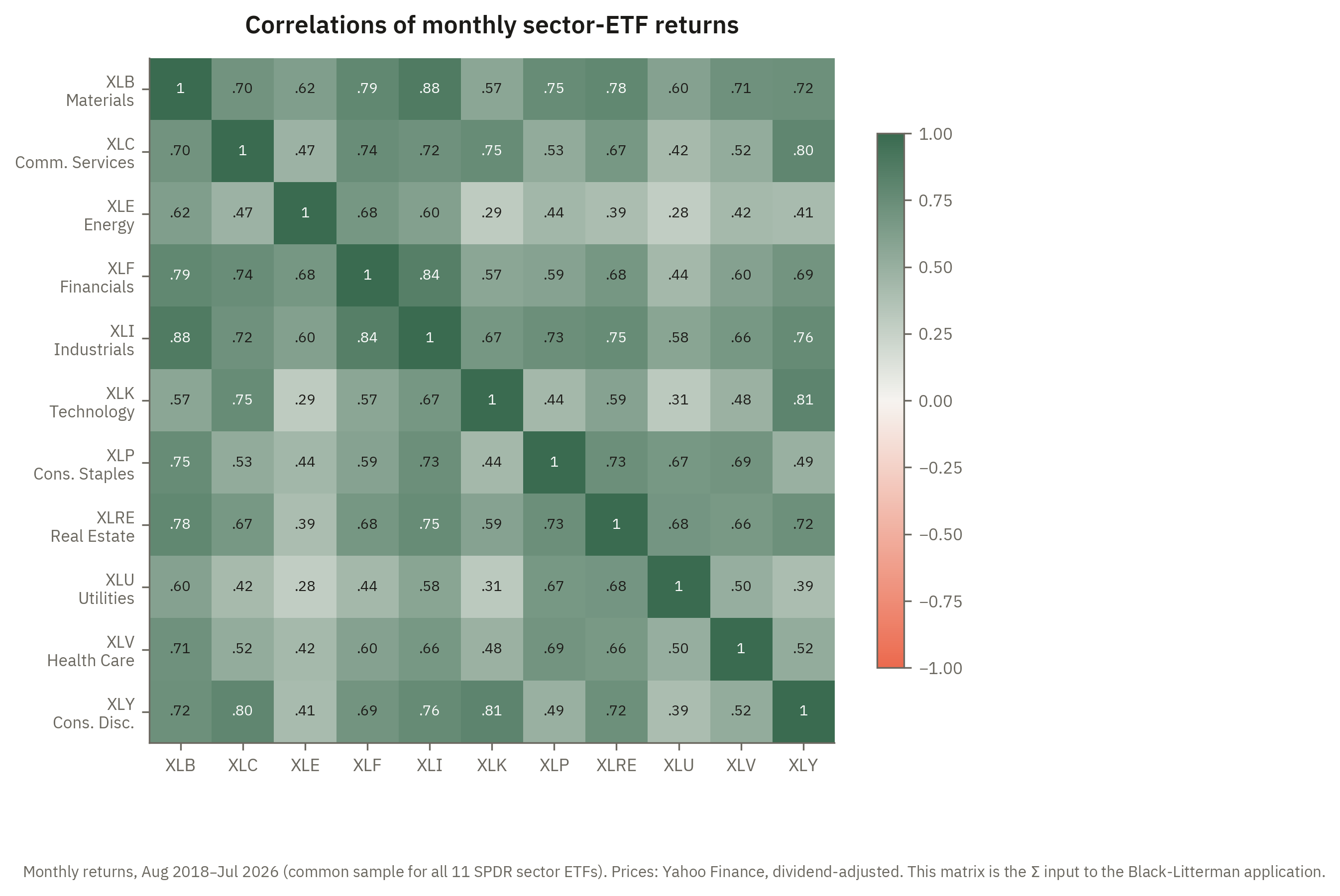
A covariance matrix printed as a table is hard to read; the same information is far more legible as the correlation heatmap in Figure 14.1, computed from the most recent eight years of monthly returns on the eleven sector ETFs. Two features matter for what follows. Every entry is positive — there is no true hedge among equity sectors, because all of them load on the market factor — but the entries range widely, from 0.29 between energy and technology to above 0.85 among the industrial-financial-materials cluster. This matrix is the \(\Sigma\) that every formula in this chapter consumes.
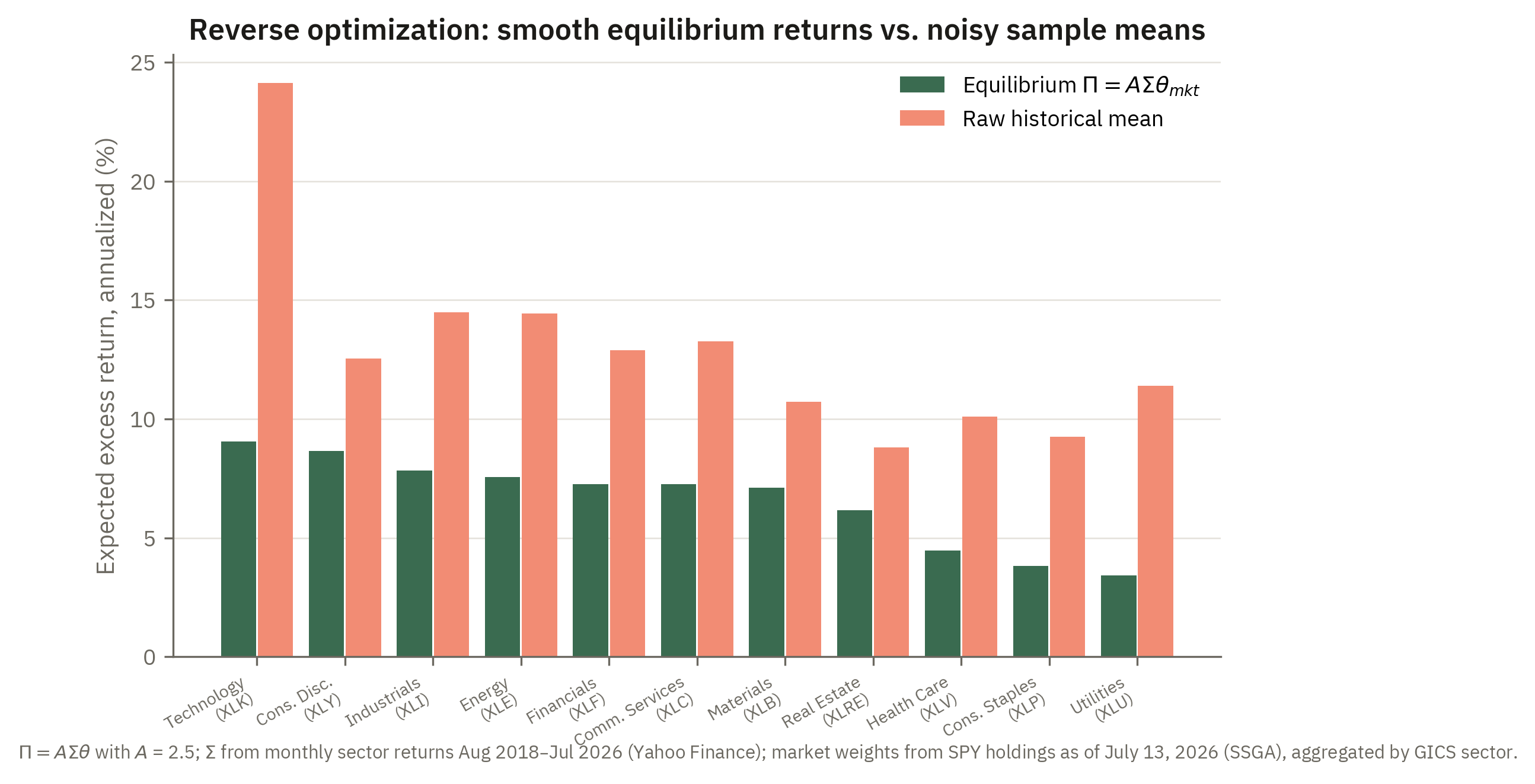
With \(\Sigma\) in hand, the reverse-optimization step \(\Pi = A\Sigma\theta_{mkt}\) needs only the market weights, and those can be read off the actual composition of the S&P 500: aggregating the current SPY holdings by sector gives technology a weight of about 37%, financials 12%, and utilities barely 2%. Figure 14.2 shows the result next to the raw historical mean returns of the same sectors, and the contrast is the whole argument for the Black-Litterman prior in one picture. The equilibrium returns \(\Pi\) line up smoothly between about 3% and 9%, ordered by covariance with the market portfolio, exactly as the first-order condition requires. The sample means, by contrast, are scattered from 9% to 24% with no visible economic logic — technology’s enormous mean reflects one extraordinary decade, not an expectation anyone should carry forward. Feeding those means into an unconstrained optimizer produces the extreme portfolios described in the introduction; starting from \(\Pi\) produces the market portfolio, which is why equilibrium returns, not sample means, are the model’s point of departure.
14.6 Application: A CIO sizing a view
The chief investment officer of a large pension or sovereign-wealth fund begins from an uncomfortable fact: simply owning the whole market means holding an enormous, concentrated bet on whatever the market happens to favor. The Black–Litterman framework is built for exactly her problem. It lets her start from the returns implied by market equilibrium — the portfolio she would hold if she had no special opinions — and then blend in her house views, such as a belief that one region or sector is overvalued, in proportion to how confident she is. The result is a set of portfolio tilts that are disciplined rather than arbitrary: large where conviction is high, small where it is weak, and always anchored to the market. For an investor managing hundreds of billions, this is the difference between expressing a view and accidentally betting the fund on it.
Odd Lots (Bloomberg) — “Cullen Roche on the Art of Building a Perfect Portfolio”: how to combine the market portfolio with your own views into a coherent allocation — the problem Black–Litterman formalizes.
14.7 Homework problems
14.7.1 Conceptual
BL-C1. An analyst runs an unconstrained mean-variance optimization on 11 sector ETFs using historical sample means as her estimates of \(\mu\). She reports that XLK receives a weight of \(+340\%\) and XLE a weight of \(-210\%\). A colleague re-estimates the sample means using a data window that is only two months longer and now finds XLE receives \(+180\%\) and XLK receives \(-90\%\). Using the chapter’s discussion of the failure mode of unconstrained optimization, explain why such a small change in the input estimates can flip the signs and magnitudes of the optimal weights so dramatically. In your answer, refer to how the optimizer treats the point estimates of \(\mu\).
BL-C2. The chapter opens by asking why standard mean-variance optimization “so often produces extreme and unstable portfolio weights in practice.” Explain the root cause the chapter identifies, and then explain the structural remedy Black-Litterman offers: how does treating expected returns as random variables with a prior distribution, rather than as fixed parameters, prevent the optimizer from over-fitting noisy return estimates?
BL-C3. The chapter builds its prior over expected returns by “reverse-engineering” the returns that make the observed market-cap weights optimal. Explain, in words, the logic of this reverse-optimization step: what equation is being solved, what is treated as known, and what is being backed out. Then explain why anchoring the prior to market weights is a sensible default choice for an investor who begins by effectively owning the whole market.
BL-C4. Two portfolio managers each build a mean-variance optimizer. Manager A feeds in raw historical sample means for \(\mu\). Manager B first computes the equilibrium prior \(\Pi = A\Sigma\theta_{\text{mkt}}\) and uses that as her baseline, tilting away from it only where she has a view. Explain why Manager B’s portfolios are likely to be more stable and more intuitively reasonable than Manager A’s, even before either manager has expressed any subjective view. What structural feature of the reverse-optimization prior is doing the work here?
BL-C5. In the Black-Litterman setup the investor does not treat expected returns as fixed numbers; instead she writes \(\mu = \Pi + \epsilon^{e}\) with \(\epsilon^{e} \sim N(0, \tau\Sigma)\). Explain what economic content the parameter \(\tau\) carries. What does it mean, in terms of the investor’s confidence in the equilibrium prior, to choose a very small \(\tau\) versus a large \(\tau\)? Contrast this treatment of \(\mu\) with the classical assumption that \(\mu\) is a known constant.
BL-C6. Explain why the chapter scales the prior uncertainty of expected returns by \(\tau\Sigma\) — that is, why the covariance of \(\epsilon^{e}\) is taken to be proportional to the return covariance matrix \(\Sigma\) rather than, say, an unrelated diagonal matrix. What does this modeling choice say about how the investor believes uncertainty about mean returns is distributed across assets, and why is it convenient when the posterior formula is derived?
BL-C7. A manager holds a single view: that XLK will outperform XLE by some amount \(q\). She has collected considerable research supporting this view and is highly confident. A second manager holds the identical directional view but describes it as “a hunch.” Using the Bayesian updating logic of the chapter, explain how the two managers’ posterior expected returns will differ, and identify precisely which input to the model encodes the difference between “highly confident” and “a hunch.”
BL-C8. The chapter represents a set of \(m\) views through the matrix \(P\), the vector \(Q\), and the diagonal covariance \(\Omega\), writing \(P\mu = Q + \epsilon^{v}\). Explain what a single row of \(P\) encodes, what the corresponding entry of \(Q\) specifies, and what the corresponding diagonal entry of \(\Omega\) controls. Why is a view naturally written as a linear combination of asset returns rather than as a statement about one asset in isolation?
BL-C9. In the Black-Litterman model, assets about which the investor expresses no view are described as being “unaffected” (or only mildly affected) by the updating. Explain why the model has this conservative property, referring to the structure of the view matrix \(P\). Contrast this with what happens in a naive optimizer where a single revised estimate of one asset’s expected return can move the weights of many unrelated assets.
BL-C10. The posterior mean \(\bar\mu = \left[(\tau\Sigma)^{-1} + P'\Omega^{-1}P\right]^{-1}\left[(\tau\Sigma)^{-1}\Pi + P'\Omega^{-1}Q\right]\) is described as a precision-weighted blend of the prior and the views. Explain, in terms of the matrices \((\tau\Sigma)^{-1}\) and \(P'\Omega^{-1}P\), why the posterior mean is always a compromise between \(\Pi\) and the views, and explain what happens to the blend as \(\Omega \to \infty\) (views become worthless) and as \(\Omega \to 0\) (views become certain).
BL-C11. Explain the relationship the chapter draws between the confidence in a view and the size of the resulting tilt away from the market portfolio. Describe two extreme cases — a view held with near-certainty and a view held with almost no confidence — and state what happens to the posterior expected returns, and hence to the optimal weights, in each case.
BL-C12. A CIO says: “I like Black-Litterman because it lets me express opinions without betting the fund.” Interpret this statement in light of the chapter’s material. Explain how starting from the equilibrium prior and scaling tilts by conviction accomplishes exactly this, and describe what would go wrong if she instead simply set the expected returns of her favored sectors to large positive numbers and re-optimized.
14.7.2 Quantitative
BL-Q1. (Reverse optimization / implied equilibrium returns.) An investor has risk aversion \(A = 3\). There are two assets with market-cap weights \(\theta = (0.6, 0.4)'\) and covariance matrix \[\Sigma = \begin{pmatrix} 0.04 & 0.01 \\ 0.01 & 0.02 \end{pmatrix}.\] Using the first order condition \(\mu = A\Sigma\theta\), compute the implied equilibrium expected return vector \(\Pi\) (i.e., set \(\Pi = A\Sigma\theta\)). Report both components.
BL-Q2. (Reverse optimization / implied equilibrium returns.) Using the same \(\Sigma\) and \(\theta\) as in BL-Q1 but with risk aversion \(A = 5\), recompute \(\Pi = A\Sigma\theta\). Then verify, by plugging your \(\Pi\) back into \(\mu = A\Sigma\theta\) and solving for \(\theta\), that the market weights \((0.6, 0.4)'\) are recovered as the optimal portfolio. Briefly state why they must be recovered.
BL-Q3. (Single-view specification \(p\), \(q\), \(\omega\).) Consider three assets ordered (XLB, XLK, XLE). An investor believes that a portfolio long XLK and short XLE by equal amounts will have an expected return of \(q = 0.015\) per month, and she assigns this view a standard deviation of \(\omega = 0.05\). Write down the view vector \(p\), state the scalar \(q\), and state the variance \(\omega^2\) of the view error \(\epsilon^{v}\). Then confirm that \(p\mu\) picks out \(\mu_{\text{XLK}} - \mu_{\text{XLE}}\) from the mean vector \(\mu = (\mu_{\text{XLB}}, \mu_{\text{XLK}}, \mu_{\text{XLE}})'\).
BL-Q4. (General view specification \(P\), \(Q\), \(\Omega\).) An investor tracking four assets ordered (A, B, C, D) holds two views: (i) A will outperform B by \(0.010\); (ii) C will have an expected return of \(0.008\) in absolute terms. She assigns the views error standard deviations \(0.04\) and \(0.06\) respectively, and treats them as independent. Write down the \(2\times 4\) matrix \(P\), the vector \(Q\), and the \(2\times 2\) diagonal covariance matrix \(\Omega\).
BL-Q5. (Black-Litterman posterior mean, single view, scalar case.) To make the posterior mean formula hand-computable, take a one-asset world so all matrices are scalars. Let \(\tau\Sigma = 0.02\), prior \(\Pi = 0.006\), view \(p = 1\), view value \(q = 0.012\), and view variance \(\omega^2 = 0.01\). Using \[\bar\mu = \left[(\tau\Sigma)^{-1} + p'\tfrac{1}{\omega^{2}}p\right]^{-1}\left[(\tau\Sigma)^{-1}\Pi + p'\tfrac{1}{\omega^{2}}q\right],\] compute the posterior expected return \(\bar\mu\). Show that it lies between the prior \(0.006\) and the view \(0.012\), and state which one it is closer to and why.
BL-Q6. (Black-Litterman posterior mean and confidence.) Using all the same numbers as in BL-Q5 (\(\tau\Sigma = 0.02\), \(\Pi = 0.006\), \(p = 1\), \(q = 0.012\)), recompute the posterior mean \(\bar\mu\) for two different confidence levels: (a) a very confident view with \(\omega^2 = 0.001\), and (b) a very unconfident view with \(\omega^2 = 0.2\). Report both values of \(\bar\mu\) and explain how they illustrate the chapter’s point that higher confidence (lower \(\omega^2\)) pulls the posterior more strongly toward the view.
BL-Q7. (Posterior variance, scalar case.) Using the same scalar inputs as in BL-Q5 (\(\tau\Sigma = 0.02\), \(p = 1\), \(\omega^2 = 0.01\)), compute the posterior variance of \(\mu\), \[\left[(\tau\Sigma)^{-1} + p'\tfrac{1}{\omega^{2}}p\right]^{-1}.\] Compare it to the prior variance \(\tau\Sigma = 0.02\) and to the view variance \(\omega^2 = 0.01\), and explain why the posterior variance must be smaller than both. Then recompute it for the very confident case \(\omega^2 = 0.001\) and comment on what happens.
BL-Q8. (Role of \(\tau\) in the posterior weighting.) In the scalar posterior mean of BL-Q5, the relative weight placed on the prior versus the view is governed by \((\tau\Sigma)^{-1}\) against \(1/\omega^2\). Fix \(\Sigma = 0.02\) (so with \(\tau = 1\), \(\tau\Sigma = 0.02\)), \(\Pi = 0.006\), \(q = 0.012\), and \(\omega^2 = 0.01\). Compute the posterior mean \(\bar\mu\) for \(\tau = 0.1\) and for \(\tau = 1.0\), and explain the direction in which shrinking \(\tau\) moves the posterior, in terms of confidence in the equilibrium prior.
BL-Q9. (From posterior returns to a tilt.) Continue from BL-Q1, where \(A = 3\), \(\Sigma = \begin{pmatrix} 0.04 & 0.01 \\ 0.01 & 0.02 \end{pmatrix}\), and market weights \(\theta_{\text{mkt}} = (0.6, 0.4)'\) give equilibrium returns \(\Pi\). Suppose Bayesian updating raises the posterior expected return of asset 1 above its equilibrium value while leaving asset 2 unchanged, giving posterior mean \(\bar\mu = \Pi + (0.006, 0)'\). Using the FOC \(\bar\mu = A\Sigma\theta\), solve for the new optimal weights \(\theta = \tfrac{1}{A}\Sigma^{-1}\bar\mu\) and report the tilt \(\theta - \theta_{\text{mkt}}\). Comment on why raising only asset 1’s expected return nonetheless changes both weights.
BL-Q10. (From posterior returns to a tilt, negative view.) Using the same \(A = 3\), \(\Sigma\), and \(\theta_{\text{mkt}} = (0.6, 0.4)'\) as in BL-Q9, suppose instead that updating lowers asset 2’s posterior expected return while leaving asset 1 unchanged, giving \(\bar\mu = \Pi + (0, -0.007)'\). Solve for the new optimal weights \(\theta = \tfrac{1}{A}\Sigma^{-1}\bar\mu\) and report the tilt \(\theta - \theta_{\text{mkt}}\). Explain the sign of each component of the tilt in light of the positive covariance between the two assets.
14.7.3 Data exercises
These problems use the live-data figures in this chapter.
BL-D1. A two-sector version of Figure 14.2: let \(A = 2.5\), market weights \(\theta_{mkt} = (0.7, 0.3)'\), and \(\Sigma = \begin{pmatrix} 0.04 & 0.01 \\ 0.01 & 0.02 \end{pmatrix}\) (annualized). (a) Compute the implied equilibrium excess returns \(\Pi = A\Sigma\theta_{mkt}\). (b) Explain why the first sector’s \(\Pi\) is higher, and relate this to the figure, where technology (weight \(37\%\), high covariance with the market) has the highest equilibrium return and utilities (weight \(2\%\), low covariance) the lowest.
BL-D2. In Figure 14.2 the raw historical mean for technology is about \(24\%\) per year, while its equilibrium return \(\Pi\) is about \(9\%\). (a) Describe what an unconstrained mean-variance optimizer would do if fed the historical means, and why (cite the correlations in Figure 14.1 in your answer). (b) Explain why the Black-Litterman model instead anchors on \(\Pi\) and lets the investor’s views — not sample means — move the portfolio away from market weights.
Satchell, Stephen, and Alan Scowcroft. "A demystification of the Black-Litterman model: Managing quantitative and traditional portfolio construction." In Forecasting expected returns in the financial markets, pp. 39-53. Academic Press, 2007.↩︎