10 The Yield Curve
10.1 Introduction
Three questions are at the heart of the study of the yield curve. First, how does the arbitrage principle relate yields of different maturities to one another, and what does this imply about bond pricing when the yield curve is not flat? Second, what information about future interest rates is encoded in the forward rates that can be extracted from the term structure today — and can an investor lock in those rates through a trading strategy? Third, why does the yield curve typically slope upward, and is that slope driven by expectations about rising short rates, by risk premia demanded by investors, or by some combination of both? These questions are central to financial markets because the yield curve is among the most closely watched signals in global finance. Central banks use it to assess the transmission of monetary policy; corporations use it to time debt issuance; mortgage lenders use it to set long-term rates; and investors use it to infer the market’s collective view of the macroeconomic outlook. A rigorous understanding of how the curve is constructed, what it implies, and why it takes the shape it does is indispensable for fixed income analysis.
The first question establishes that bonds of different maturities cannot be priced independently of one another. Once zero-coupon spot rates for various maturities are observed, the no-arbitrage principle requires that every coupon-paying bond be priced by discounting each cash flow at the spot rate appropriate for its timing. If this were not the case, the bond could be stripped into its individual zero-coupon components and the pieces reassembled or sold separately for a riskless profit. This stripping and reconstitution argument pins down the entire pricing structure for fixed income instruments once the spot curve is known.
The second question concerns forward rates — the future short-term rates that are mathematically implied by today’s spot curve. The chapter shows that under certainty, the forward rate is identical to the future short rate, and that the yield to maturity on any bond is simply the geometric average of the implied short rates over its life. More practically, it demonstrates how an investor or borrower can use existing zero-coupon bonds to lock in a future borrowing or lending rate today, effectively trading at the forward rate. This result has direct application for institutions that need to hedge future financing costs.
The third question requires moving beyond arbitrage to theories of investor behavior. The expectations hypothesis asserts that forward rates are unbiased forecasts of future short rates, so the yield curve slopes upward only when the market expects rates to rise. The liquidity preference theory offers an alternative: most investors have relatively short horizons, and they demand a premium — a liquidity premium — to hold long-term bonds that expose them to interest rate risk. Under this theory, the curve can slope upward even when short rates are not expected to rise. The chapter uses Jensen’s inequality to derive precise conditions under which each theory implies a particular relationship between forward rates and expected future short rates, providing a formal foundation for the debate.
The chapter opens by explaining the stripping of coupon bonds into zero-coupon components and deriving spot rates from observed prices, then shows how these spot rates pin down the pricing of coupon bonds. It next develops forward rates from the spot curve and demonstrates the geometric average relationship between yields and short rates. The chapter then develops the theoretical framework for the term structure, contrasting the expectations hypothesis with liquidity preference theory and grounding each in a treatment of investor preferences under uncertainty. It closes by working through a detailed example of using existing zero-coupon bonds to lock in a future borrowing rate at the forward rate.
The shape of the yield curve is among the most-watched signals in finance. CNBC reported that the Fed’s “favorite recession indicator” — the gap between short- and long-term Treasury yields — was flashing a warning as the curve inverted, a configuration that has preceded most U.S. recessions. Why the curve takes the shape it does, and what the forward rates embedded in it reveal about expected future rates, is the subject of this chapter. Read it at CNBC.
10.2 The Yield Curve
The United States Treasury and many other institutions like to separate bonds into their principal and coupon payments. In fact, one may think of bonds as being a conglomeration of lots of different securities. Each coupon payment represents a security that guarantees a payment (the coupon payment) to the holder at the specified price. The law of one price (i.e. the arbitrage principle) ensures that if one were to add up the price of all of these individual securities, one would get exactly the value of the group of securities.
- Example.
-
Consider a 2 year T-note paying a 10% coupon annually (for simplicity). Suppose that the price of such a security is 100% of par value. This security can be split into three pieces. One that pays 10% of par value in one year, another that pays 10% of par value in 2 years and a third that pays 100% of par value in 2 years. Suppose the price of the first security is 9% of par value, the price of the second security is 9% of par value and the price of the third is 81% of par value. What strategy should you implement? You should sell the 2 year T-note and receive 100% of par value. Then purchase the three individual securities for a total cost of 99% of par value and then go to the treasury and ask them to reconstitute the security. Once reconstituted, you give the security back to cover the one that you sold short. Since you could do this as long as the prices differ, this shows that the prices must be the same.
For many reasons, treasury securities are often split into their individual payments. This creates a set of zero-coupon bonds. From the prices of these zero-coupon bonds, one may calculate the yield to maturity for zeros of various maturities.
- Example.
-
Suppose that zeros of 1,2 and 3 years maturity with $1000 par value sell for the prices $943.396, $881.659, $816.298. What are the YTMs of these zeros? They are 6%, 6.5% and 7% respectively.
- Spot rate.
-
The currently observed yield to maturity for a particular duration. For example, "the 3-year spot rate is 10%" or "the one-year spot rate is 5%."
- Short rate.
-
The interest rate for a particular interval of time (often a short interval like 1 year). For example, "the 1 year short rate three years from now will be 5%" or "the current short rate is 10% which by definition is the current 1-year spot rate."
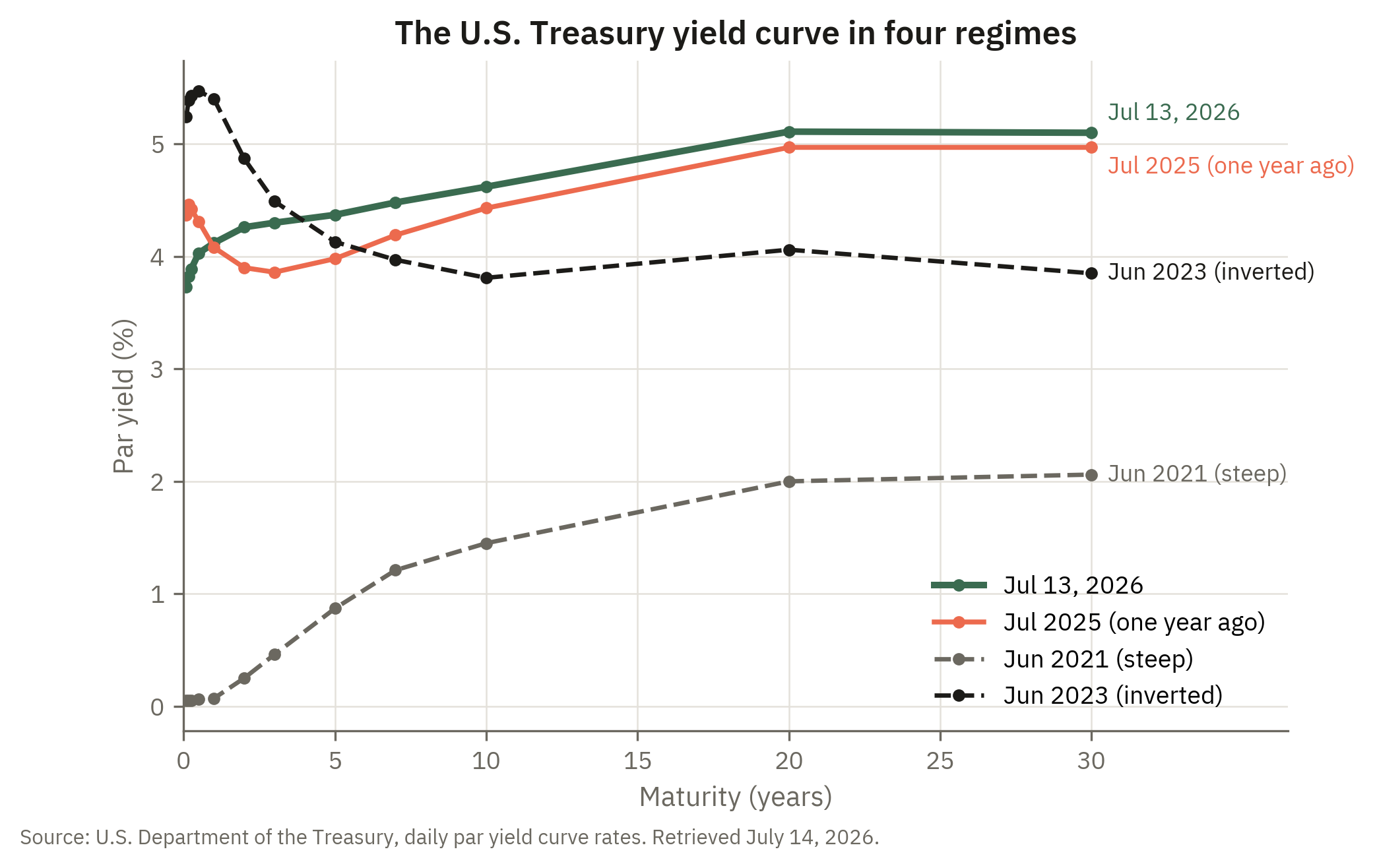
The spot rates just defined are not abstractions: the U.S. Treasury publishes a full curve of them every business day. Figure 10.1 plots that curve on four dates chosen to span the shapes the curve actually takes. In June 2021 the curve was steep — short rates pinned near zero and long rates about two percentage points higher. Two years later the same curve was inverted: the three-month rate exceeded the ten-year rate by more than a percentage point, the configuration behind the recession-indicator headlines in the news box above. Today’s curve is different again, upward sloping from around 3.7% at the short end to above 5% at twenty years. Every calculation in this chapter — stripping, spot rates, forward rates — can be carried out on the green line in this figure, and the worked examples below invite you to do exactly that.
10.3 Bond pricing
The existence of differences in yields for zeros of different maturities has implications for the pricing of bonds. In particular, a zero coupon bond to be received at time \(n\) should be discounted using the yield for other zeros of the same maturity.
- Example.
-
Suppose that the yield curve is given by (y_1,y_2). Then a risk-free bond that matures in 2 years and makes annual coupon payments of \(b\) and has face value \(M\) would have price
\[P = \frac{b}{1 + y_1} + \frac{b}{(1 + y_2)^2} + \frac{M}{(1 + y_2)^2}\]
10.4 The yield curve without interest rate risk
Under certainty the future short rate can be derived from the current yield curve. This follows from the arbitrage principle. To see this, suppose that the yield curve over one and two years is given by the interest rates \(y_1\) and \(y_2\). Consider saving $1000 today that you will consume in 2 years. You have several savings options available to you. The first is that you can put the money into a two year zero. At the end of the two years you will be paid \(1000(1 + y_2)^2\). Another option is that you can purchase a one year zero and at the end of the first year extract your money and put it into another one year zero. Both of these strategies yield exactly the same cash flow, so by the arbitrage principle they must give the same return at the end of the 2 years. Therefore, the short rate (\(r_2\)) after 1 year (for the period of the second year) must satisfy
\[1000(1 + y_2)^2 = 1000(1 + y_1)(1 + r_2)\]
which implies that \(1 + r_2 = \frac{(1 + y_2)^2}{1 + y_1}\). Thus the future short rate can be calculated from the yield curve. In particular, the yield to maturity will be the geometric average of all of the future short rates. This can be seen since \((1 + y_n)^n = (1 + r_1)(1+r_2)\cdots(1 + r_n)\) which implies that \(1 + y_n = [(1 + r_1)(1+r_2)\cdots(1 + r_n)]^{1/n}\).
This can be done generally. If \(n\) represents the maturity of a risk-free zero-coupon bond in the yield curve then in general we have that \(1 + r_n = \frac{(1+ y_n)^n}{(1 + y_{n-1})^{n-1}}\).
What is the rate of return to holding the 1 year zero vs. the 2 year zero for one year and then selling it? Since there is no uncertainty and the two investment strategies have the same payoff, their returns must be equal. To see this, note that at the end of one year, the two year zero is exactly a one year zero. As such it must have price \(P = \frac{1000}{1 + r_2}\). Therefore, the return to holding the two year zero (which was purchased for \(\frac{1000}{(1+y_2)^2}\)) will be
\[r = \frac{ \frac{1000}{1 + r_2} - \frac{1000}{(1 + y_2)^2}}{\frac{1000}{(1 + y_2)^2}} = \frac{(1+y_2)^2}{1 + r_2} - 1.\]
To simplify, substitute the no-arbitrage relation \(1 + r_2 = \frac{(1 + y_2)^2}{1 + y_1}\) from above. Then \(\frac{(1+y_2)^2}{1+r_2} = \frac{(1+y_2)^2 (1 + y_1)}{(1+y_2)^2} = 1 + y_1\), so
\[r = (1 + y_1) - 1 = y_1.\]
(The net one-year holding-period return on the two-year zero is \(y_1\) — not \(1 + y_1\); the gross return is \(1 + y_1\).) Thus the holding period returns of the two assets are equal.
- Example.
-
Suppose that the current yield curve is given by \(y_1 = 0.0230\) and \(y_2 = 0.0235\). In a world with no uncertainty, what must the 1-year short rate be one year from now? To calculate this, simply match cash flows. Investing $1 in a two-year zero will yield \(1.0235^2 = 1.04755\) at the end of two years. Investing in the 1-year zero and then rolling over will give \(1.0230(1 + r_2)\) at the end of two years. Since under certainty these must be the same we have \(1.04755 = 1.0230(1 + r_2)\) which implies that \(r_2 = 0.02400\).
Of course, future short rates of return are unknown currently. The interest rate could go up or down between now and one, two or 10 years from now.
- Forward interest rate.
-
The future short interest rate that is implied by the current yield curve. In particular, if the current yield curve is given by \((y_1,y_2,y_3,\ldots,y_T)\) then the forward rate \(f_n\) solves
\[1 + f_n = \frac{(1+ y_n)^n}{(1 + y_{n-1})^{n-1}}\]
- Example.
-
The yield curve as of 9/16/08 at approximately 1:30 pm EDT (from Bloomberg1) is \((y_1,y_2,y_3) = (0.0154,0.0174,0.0198)\). What are the forward rates \((f_2,f_3)\)?
\[\begin{aligned} f_2 = \frac{(1+y_2)^2}{1 + y_1} - 1 = \frac{1.0174^2}{1.0154} = 0.019404 \\ f_3 = \frac{(1+y_3)^3}{(1 + y_2)^2} - 1 = \frac{1.0198^3}{1.0174^2} = 0.024617 \end{aligned}\]
10.5 Theories of the yield curve
What is the relationship between the future short rate \(r_n\) and the forward rate \(f_n\)? One difference is that \(f_n\) can be calculated directly today while \(r_n\) is a random variable. Can we relate \(Er_n\) to \(f_n\)?
- Example.
-
Consider an investor who knows that she wants to invest for a two-year horizon. The investor's preferences can be represented by a utility function \(U(x)\) where \(x\) represents her consumption at the end of two years. The investor preferences over risky alternatives can be represented by the expected utility functional \(EU(x)\). Assume that the investor is risk averse so \(U(x)\) is strictly increasing in \(x\) and is strictly concave. There are two possible assets that may be used. The first is a two year, zero-coupon bond with current yield to maturity of \(y_2\). The alternative is to invest in a one-year zero coupon bond at current rate \(y_1\) and then roll this investment over at the end of one year. The payoff to this strategy will be \((1 + y_1)(1 + r_2)\) but \(r_2\) is unknown currently. If the investor were indifferent between the two assets then it must be true that \(EU((1 + y_1)(1 + r_2)) = U((1 + y_2)^2)\) (recall that the two-year return to the two-year zero is certain). Recall from Jensen's inequality that for a strictly concave function \(f(x)\) we have that \(Ef(x) < f(Ex).\) Therefore we have that
\[U(E(1+y_1)(1+r_2)) > U((1 + y_2)^2).\]
Recall that the forward rate \(f_2\) is defined as \(1 + f_2 = \frac{(1 + y_2)^2}{1 + y_1}\). From the previous equation we have that \(E(1+y_1)(1+r_2) > (1 + y_2)^2\) which implies that
\[1 + f_2 = \frac{(1 + y_2)^2}{1 + y_1} < E(1 + r_2).\]
Thus, if all investors are long term investors then the expected future short rate will be larger than the forward rate. Investors in the long-term asset do not have to deal with interest rate risk so they are willing to accept a low yield on that asset. This lower yield is inherent in \(y_2\) since \((1 + y_2)^2 = (1 + y_1)(1 + f_2)\). Investors are willing to accept an implied future short rate that is less than the expected value of the future short rate because they don't have to deal with the interest rate risk.
- Example.
-
Now consider an investor who knows that she wants to invest for only one year. She can invest in the one-year zero and earn return \(y_1\) for sure. Or she can invest in the two year security and sell it at the end of the first year. What will be the return to this strategy? It depends on the one-year short rate that is realized at the end of the year. Call this short rate \(r_2\).
\[R = \frac{ \frac{1}{1 + r_2} }{ \frac{1}{(1 + y_2)^2} } = \frac{(1 + y_2)^2}{1 + r_2}\]
If the investor is to be indifferent between the two assets it must be that
\[EU\left (\frac{(1 + y_2)^2}{1 + r_2} \right ) = U( 1 + y_1 ) = U \left ( \frac{(1 + y_2)^2}{1 + f_2} \right )\]
Again by Jensen's inequality we have that
\[U \left ( E \frac{( 1 + y_2)^2}{1 + r_2} \right ) > U \left ( \frac{(1 + y_2)^2}{1 + f_2} \right )\]
which implies that
\[E \frac{( 1 + y_2)^2}{1 + r_2} > \frac{(1 + y_2)^2}{1 + f_2}\]
That is, the expected return to holding the 2-year security will have to be larger than the return to holding the one year security because the two year zero bears the risk of the currently unknown forward spot rate \(r_2\). How does this relate to the expected future spot rate \(Er_2\)? Suppose that \(f_2 = Er_2\). Notice that \(\frac{1}{1 + r_2}\) is convex in \(r_2\) so \(E\frac{1}{1 + r_2} < \frac{1}{1 + Er_2}\) by Jensen's inequality. Multiplying both sides of this inequality by the positive constant \((1 + y_2)^2\) preserves it,
\[E \frac{(1 + y_2)^2}{1 + r_2} < \frac{(1 + y_2)^2}{1 + Er_2},\]
and substituting the supposition \(Er_2 = f_2\) into the right-hand side gives
\[E \frac{( 1 + y_2)^2}{1 + r_2} < \frac{(1 + y_2)^2}{1 + f_2}\]
which violates the previous equation. Therefore it must be that \(f_2 = Er_2 + LP\) where \(LP\) is a positive risk (or liquidity) premium that is sufficient to make it so that
\[E \frac{( 1 + y_2)^2}{1 + r_2} > \frac{(1 + y_2)^2}{1 + Er_2 + RP} = \frac{(1 + y_2)^2}{1 + f_2}\]
In other words, if all investors are short term investors then they will only be willing to hold the two-year zero if its return incorporates a positive risk premium (i.e. \(f_2 > Er_2\)).
There are two alternative hypotheses about the yield curve. One is called the expectations hypothesis which asserts that forward rates are exactly the expectation of future interest rates. As seen previously, this is equivalent to assuming either that 1) The number of short term and long term investors in the market exactly counteract each other, or 2) there exist investors in the market who are risk-neutral and so care only about expectations. An alternative hypothesis is the liquidity preference theory which asserts that most investors in the market are short term investors and so the reason that the yield curve often slopes upward is that investors require a liquidity premium to hold the longer term debt, since doing so requires one to take on interest rate risk.
10.6 Forward rates and future loans
If it is currently known that you will need access to funds in the future, one may lock in the future interest rate by using the current forward rates. Assume that the current yield curve is given by \((y_1,y_2,\ldots,y_T)\). You will need access to the amount \(x\) at time \(n\) and will repay it at time \(n+1\). The general strategy is to sell (i.e. short) enough \(n+1\)-year zeros to pay for the purchase of \(x\) dollars of \(n\)-year zeros. The \(n\)-year zeros will payoff in period \(n\), but you won't have to purchase the \(n+1\)-year zeros to cover your short position until year \(n+1\). The price of an \(n\)-year zero is \(P_n = \frac{M}{(1 + y_n)^n}\) where \(M\) is the face value of the zero. The price of the \(n+1\) year zero is \(P_{n+1} = \frac{M}{(1 + y_{n+1})^{n+1}}\).
To receive the amount \(x\) at time \(n\) you must purchase \(x/M\) units of the \(n\)-year zeros. This cost is \(\frac{x}{(1 + y_n)^n}\). To fund this position with \(n+1\)-year zeros that have face value \(M\) you must sell
\[q = \frac{(1 + y_{n+1})^{n+1}}{M(1 + y_n)^n}\]
units of the \(n+1\)-year zero to fund this position. Recall from the definition of \(f_{n+1}\) that
\[1 + f_{n+1} = \frac{(1 + y_{n+1})^{n+1}}{(1 + y_n)^n}\]
which implies that
\[q = (1 + f_{n+1}) \frac{x}{M}.\]
Thus the amount you must repay in period \(n+1\) is \(qM = (1 + f_{n+1}) x\). That is, you received \(x\) at the beginning of period \(n\) and must repay \((1 + f_{n+1})x\) at the beginning of period \(n+1\). You have effectively taken a loan of \(x\) at time \(n\) at rate \(f_{n+1}\).
- Example.
-
Suppose that you want to raise $1M from the capital markets to be received by you in one year and payed off one year later. Assume that one-year and two-year zeros have face value \(M = \$1000\). The current yield curve is \((y_1,y_2) = (0.0154,0.0174)\). So the price of the one year zero is \(1000/1.0154 = 984.834\). The price of the two year zero is \(1000/1.0174^2 = 966.0877\). To have $1M in one year you will need purchase 1000 one year zeros in the market. This will cost you $984,834. In order to raise that capital you start by selling \(q = 984,834/966.0877 = 1019.404\) two year zeros in the market. This gives you $984,834 to be used to purchase the 1 year zeros. In 1 year you will have exactly $1M dollars as a payoff from the one year zeros. In two years you will need to purchase all of the two year zeros that you owe so that you can pay back the person from whom you borrowed them. How much will this cost? The value of the two year zeros in two years will be \(1000\cdot 1019.404 = \$1,019,404\). Thus you will have paid $19,404 in interest on the one year loan. Recall from before that \(f_2 = 0.019404\).
10.7 Application: A bank treasurer managing the gap
The treasurer of a regional bank must decide how much to fund long-dated loans with short-term deposits — a choice that determines both the bank’s profit and its vulnerability. The term structure of interest rates is the treasurer’s map. The shape of the yield curve, and the forward rates embedded in it, reveal what the market expects future short rates to be and how much extra return long maturities currently offer; the expectations hypothesis and the role of term premia explain why the curve slopes as it does. Reading that signal is not academic: a treasurer who borrows short and lends long without accounting for how the curve can move is exposed to exactly the maturity mismatch that destroyed Silicon Valley Bank when rates rose, and the analysis in this chapter is what allows the risk to be measured and managed rather than ignored.
The Indicator from Planet Money (NPR) — “The inverted yield curve is screaming RECESSION”: why the slope of the yield curve has predicted past recessions, and what an inversion really means.
10.8 Homework problems
10.8.1 Conceptual
YC-C1. A trader claims that a coupon-paying two-year T-note can be priced by discounting all of its cash flows at the single two-year spot rate \(y_2\). Explain, using the stripping-and-reconstitution (no-arbitrage) argument, why this is incorrect when the yield curve is not flat, and state the correct pricing rule for each of the note’s cash flows.
YC-C2. A colleague argues that if a coupon bond and a portfolio of zeros replicating its cash flows sold at different prices, “the market would just eventually correct.” Explain instead the immediate arbitrage trade (which security to buy, which to sell, and the role of the Treasury’s stripping and reconstitution facility) that forces the coupon bond’s price to equal the sum of the values of its stripped cash flows. Why does the mere possibility of this trade pin down the price, regardless of investor sentiment?
YC-C3. A colleague states, “The three-year spot rate \(y_3\) tells us the market’s forecast of the short rate that will prevail three years from now.” Explain why this statement confuses a spot rate with a forward (or short) rate. In your answer, describe precisely what \(y_3\) measures today, what the forward rate \(f_3\) measures, and how the two are related through the definition \(1 + f_3 = \frac{(1+y_3)^3}{(1+y_2)^2}\).
YC-C4. Carefully distinguish the three rate concepts used in this chapter — the spot rate \(y_n\), the short rate \(r_n\), and the forward rate \(f_n\) — by stating which are observable today and which are (in general) random variables. Explain why \(f_n\) and \(r_n\) coincide in a world of certainty but generally differ under uncertainty, and why \(y_n\) can always be written as a geometric average of a sequence of rates.
YC-C5. Explain how an investor who knows she will need to borrow money one year from now, and repay it two years from now, can lock in today’s forward rate \(f_2\) without any uncertainty. Describe the trading strategy in words (which zeros to buy, which to short) and explain why the effective borrowing rate is exactly \(f_2\) rather than \(y_1\) or \(y_2\).
YC-C6. A borrower says, “To lock in a future loan I would need a counterparty willing to sign a forward contract with me today.” Explain why, given a full set of zero-coupon bonds, no such explicit forward contract is necessary: describe how the long-and-short zero position manufactures the forward loan synthetically, and identify precisely at which dates cash flows in and out so that nothing changes hands between today and the start of the loan.
YC-C7. The chapter shows that if all investors are long-term (two-year-horizon) investors, then \(f_2 < Er_2\), whereas the expectations hypothesis asserts \(f_2 = Er_2\). Explain in words why a market populated entirely by long-horizon investors produces a forward rate below the expected future short rate. What feature of the two-year zero makes those investors willing to accept a lower implied rate, and how does Jensen’s inequality enter the argument?
YC-C8. Under the expectations hypothesis, an upward-sloping yield curve is interpreted as a signal that the market expects future short rates to rise. Explain the reasoning that connects the slope of the curve to expected future short rates under this hypothesis, using the relationship \(f_n = Er_n\). What would a downward-sloping (inverted) curve imply about \(Er_n\) relative to today’s short rate?
YC-C9. According to the liquidity preference theory, the yield curve can slope upward even when the market expects short rates to remain unchanged. Using the decomposition \(f_2 = Er_2 + LP\) with \(LP > 0\), explain why this is possible and what economic force \(LP\) represents. Contrast this interpretation of an upward slope with the expectations-hypothesis interpretation.
YC-C10. The chapter derives that if all investors are short-term (one-year-horizon) investors, then \(f_2 > Er_2\), so a positive liquidity premium \(LP = f_2 - Er_2\) is required for anyone to hold the two-year zero. Explain intuitively why short-horizon investors demand this premium, and why it is these investors — not the long-horizon investors — whose behavior the liquidity preference theory takes to dominate the market.
YC-C11. Under the assumption of certainty, the chapter shows that buying a two-year zero and selling it after one year earns exactly the same net one-year holding-period return as simply holding a one-year zero, namely \(y_1\). Explain in words why the no-arbitrage principle forces these two strategies to have equal one-year returns. Be careful to state whether it is the net return or the gross return that equals \(y_1\), and give the value of the other one.
YC-C12. A student writes on an exam that “the one-year holding-period return on a two-year zero equals \(1 + y_1\).” Explain precisely what is wrong with this statement, distinguishing the gross return (one plus the net return) from the net return. Identify which of \(y_1\) and \(1 + y_1\) is the net one-year holding-period return and which is the gross return, and show where in the derivation the “\(-1\)” enters.
YC-C13. Suppose that on a given morning the spread between the 10-year and 3-month Treasury yields turns negative (the curve inverts), and financial news outlets warn of a possible recession. Drawing on the chapter’s framing of the yield curve as a signal, explain what an inverted curve implies about the market’s expectations for future short rates under the expectations hypothesis, and why a bank treasurer who borrows short and lends long should pay attention to this configuration.
YC-C14. The bank-treasurer application describes funding long-dated loans with short-term deposits — “borrowing short and lending long.” Using the language of spot rates, forward rates, and term/liquidity premia developed in this chapter, explain both why this maturity mismatch is typically profitable when the curve slopes upward and why it is risky. Connect the risk explicitly to the possibility that realized future short rates \(r_n\) differ from today’s forward rates \(f_n\).
10.8.2 Quantitative
YC-Q1. The current yield curve is \((y_1, y_2, y_3) = (0.030, 0.035, 0.038)\). Consider a two-year risk-free note with face value \(M = \$1000\) paying an annual coupon of \(b = \$60\). Using the no-arbitrage rule \(P = \frac{b}{1+y_1} + \frac{b + M}{(1+y_2)^2}\), compute the price of the note. Then show that discounting both cash flows at the single rate \(y_2\) gives a different (incorrect) price.
YC-Q2. Zeros of 1-, 2-, and 3-year maturity with $1000 par sell for $970.874, $942.596, and $915.142 respectively. (a) Extract the spot rates \(y_1, y_2, y_3\). (b) Use them to price a three-year note with face value $1000 and annual coupon $50 by discounting each cash flow at the spot rate of matching maturity.
YC-Q3. The current yield curve is \((y_1, y_2, y_3) = (0.030, 0.035, 0.038)\). Compute the forward rates \(f_2\) and \(f_3\) using \(1 + f_n = \frac{(1+y_n)^n}{(1+y_{n-1})^{n-1}}\).
YC-Q4. Zero-coupon bonds with $1000 par sell for the following prices: the 1-year zero for $952.381 and the 2-year zero for $898.452. Extract the spot rates \(y_1\) and \(y_2\), then compute the forward rate \(f_2\).
YC-Q5. Suppose the future short rates under certainty are \(r_1 = 0.020\), \(r_2 = 0.030\), and \(r_3 = 0.040\). Using the geometric-average relationship \((1 + y_n)^n = (1 + r_1)(1 + r_2)\cdots(1 + r_n)\), compute the three-year spot rate \(y_3\).
YC-Q6. The two-year spot rate is \(y_2 = 0.05\) and the one-year spot rate is \(y_1 = 0.04\). Under the assumption of certainty, use the arbitrage relation \((1 + y_2)^2 = (1 + y_1)(1 + r_2)\) to find the one-year short rate \(r_2\) that will prevail one year from now.
YC-Q7. The current yield curve is \((y_1, y_2) = (0.04, 0.05)\) and each zero has face value $1000. An investor buys the two-year zero today and sells it after one year, once it has become a one-year zero. Under certainty: (a) compute the purchase price today; (b) compute the one-year short rate \(r_2\) and hence the resale price after one year; (c) compute the net one-year holding-period return and verify it equals \(y_1\); and (d) state the corresponding gross return.
YC-Q8. A two-year zero with $1000 par is bought today at a one-year spot rate \(y_1 = 0.03\) and two-year spot rate \(y_2 = 0.045\), and sold after one year under certainty. Compute the resale price and the gross one-year holding-period return \(\frac{\text{resale price}}{\text{purchase price}}\). Confirm that the net return equals \(y_1 = 0.03\), and explain in one sentence why reporting \(1 + y_1\) as the holding-period return would be an error.
YC-Q9. The current yield curve is \((y_1, y_2) = (0.0154, 0.0174)\), matching the chapter example. Under the expectations hypothesis, the market expects the one-year short rate one year from now to equal the forward rate: \(Er_2 = f_2\). Compute \(f_2\) and hence \(Er_2\). Then, if instead the liquidity preference theory holds with a premium \(LP = 0.004\) and the forward rate is unchanged, compute the implied expected future short rate \(Er_2\) from \(f_2 = Er_2 + LP\).
YC-Q10. Suppose \(y_1 = 0.03\), and the market’s expected future one-year short rate is \(Er_2 = 0.05\). (a) Under the expectations hypothesis (\(f_2 = Er_2\)), determine the two-year spot rate \(y_2\) consistent with this expectation, using \((1 + y_2)^2 = (1 + y_1)(1 + f_2)\). (b) Now suppose instead that a liquidity premium \(LP = 0.01\) raises the forward rate to \(f_2 = Er_2 + LP\); recompute \(y_2\) and comment on how the premium steepens the curve.
YC-Q11. You want to raise $2M from the capital markets to be received in one year and repaid one year later. One-year and two-year zeros have face value \(M = \$1000\). The current yield curve is \((y_1, y_2) = (0.020, 0.025)\). Compute (a) the price of each zero, (b) how many one-year zeros you must buy to receive $2M in one year, (c) how many two-year zeros \(q\) you must short to fund the purchase, and (d) the total amount you must repay in two years. Verify that the effective interest paid corresponds to the forward rate \(f_2\).
YC-Q12. Using the general result that a loan of \(x\) received at time \(n\) and repaid at time \(n+1\) carries effective rate \(f_{n+1}\), suppose the yield curve is \((y_1, y_2, y_3) = (0.030, 0.035, 0.040)\) and you wish to lock in a loan of \(x = \$500{,}000\) to be received at time 2 and repaid at time 3. Compute the forward rate \(f_3\), the number of zeros involved via \(q = (1 + f_3)\frac{x}{M}\) with \(M = \$1000\), and the amount \((1 + f_3)x\) you must repay at time 3.
10.8.3 Data exercises
These problems use the live-data figures in this chapter.
YC-D1. Reading from the current (green) curve in Figure 10.1, the one-, two-, and three-year par yields are approximately \((y_1, y_2, y_3) = (0.0412, 0.0426, 0.0430)\). Compute the implied forward rates \(f_2\) and \(f_3\). Then compare your answers with the forward rates computed in the chapter from the September 2008 curve, and explain in one sentence why today’s forwards sit so close to today’s spots while the 2008 curve implied sharply rising short rates.
YC-D2. In June 2023 (Figure 10.1, dashed black line) the three-month yield was near \(5.4\%\) while the ten-year yield was near \(3.8\%\). State what this inversion implies about expected future short rates under the expectations hypothesis. Then explain how the liquidity preference theory changes the reading: is the market’s implied expected decline in short rates larger or smaller than the raw forward rates suggest? Justify using \(f_n = Er_n + LP\) with \(LP > 0\).
http://www.bloomberg.com/markets/rates/index.html↩︎