11 Fixed Income Portfolio Management
11.1 Introduction
Three questions drive the analysis of fixed income portfolio management. First, how sensitive is a bond’s price to a change in interest rates, and how can that sensitivity be measured and summarized in a tractable way? Second, how can a portfolio manager use that measure to construct a portfolio that is protected — immunized — against the losses that arise when yields shift unexpectedly? Third, why does duration-based immunization break down for large yield movements, and what additional tool is needed to achieve more accurate hedging? These questions are of direct practical importance to any institution that holds fixed income assets or issues fixed income liabilities. Pension funds must ensure that the present value of their assets tracks the present value of their obligations; insurance companies must fund future claims; banks must manage the mismatch between the durations of their loan portfolios and their deposit liabilities. A rigorous framework for measuring and managing interest rate risk is therefore not merely an academic exercise but a core competency of institutional finance.
The first question leads to the concept of duration. Macaulay’s duration is the time-weighted average of the present values of a bond’s cash flows — effectively the center of gravity of the payment stream — and provides an intuitive summary of when, on average, the bondholder receives value. Modified duration translates this directly into a first-order approximation: a bond with modified duration \(D^*\) will lose approximately \(D^* \Delta y\) percent of its value for each percentage-point increase in yield. This makes precise the familiar intuition that long-maturity, low-coupon bonds are far more sensitive to rate changes than short-maturity, high-coupon bonds, and it provides a single number that can be compared and aggregated across an entire portfolio.
The second question leads to the strategy of immunization. If the duration of a portfolio of assets equals the duration of the corresponding liabilities, then a small parallel shift in yields will change the two sides of the balance sheet by approximately the same amount, leaving the net position intact. The chapter works through this strategy concretely, showing how a company that has issued an annuity-like obligation can select a zero-coupon bond — choosing both its face value and its maturity — so that the two sides of the portfolio are duration-matched and the net value is insensitive to small yield changes.
The third question arises because duration is only a first-order, linear approximation. As the magnitude of yield changes increases, the linear approximation loses accuracy, and a duration-matched portfolio can still show residual losses or gains depending on the curvature of the price-yield relationship. This curvature is captured by convexity — the second derivative of bond price with respect to yield — which is almost always positive for standard bonds. Convexity is generally a desirable property: for a given duration, a more convex bond gains more when yields fall and loses less when yields rise. Matching both duration and convexity across assets and liabilities extends the accuracy of immunization to larger yield movements.
The chapter begins by deriving the price sensitivity of bonds using calculus, introducing modified duration and Macaulay’s duration and establishing their key properties — including that a zero-coupon bond’s duration equals its maturity and that duration falls as the coupon rate rises. It then develops the immunization strategy through detailed examples and closes with a treatment of convexity, demonstrating how second-order hedging extends the robustness of an immunized portfolio.
Duration is not a dry statistic — it can sink a bank. NPR explained how Silicon Valley Bank loaded up on long-term government bonds and then watched their market value collapse as interest rates rose in 2022, leaving it with billions in losses when it was forced to sell. A bank or pension that matches the duration of its assets to its liabilities — the immunization strategy in this chapter — is protected from exactly that shock. Read it at NPR.
11.2 The sensitivity of bond prices to yields
Interest rate risk is one of the principle risks faced by the manager of a bond portfolio. Changes in yield affect the value of a bond. This can be seen from definition of yield to maturity. A bond that matures in T periods, pays the coupon \(b\), has face value \(M\) and price \(P\) will have a YTM defined by
\[P = \sum_{t=1}^{T} \frac{b}{(1 + y)^t} + \frac{M}{(1+y)^T}\]
Suppose that you were to ask yourself the question "If yields change by a small amount (say \(\Delta y\)), what would be the approximate change in the value of the bond?" Since you know calculus you know that a good approximation for small \(\Delta y\) is given by
\[\Delta P = \frac{\partial P}{\partial (1+y)} \Delta y.\]
If you wanted to know the percent change in price (i.e. the return) that arises from a small change in yield you would calculate
\[\frac{\Delta P}{P} = \frac{\partial P}{ P \partial (1+y)} \Delta y = -D^{*} \Delta y\]
The quantity \(D^{*}\) is called a bond's modified duration. For what follows, let \(CF_t\) represent the cash flows to the bond in question where \(CF_t = b\) for all \(t < T\) and \(CF_T = b + M\).
- Modified duration.
-
For a bond with price \(P\), and current YTM \(y\) the bond's modified duration is given by
\[D^{*} = -\frac{\partial P}{ P \partial (1+y)}\]
The modified duration of a bond with cash flows \(CF_t\) is given by
\[D^{*} = \frac{1}{P} \sum_{t=1}^{T} \frac{t CF_{t}}{(1+y)^{t+1}}\]
To obtain the closed form, differentiate the pricing equation \(P = \sum_{t=1}^{T} CF_t (1+y)^{-t}\) term by term with respect to \((1+y)\). Using the power rule, \(\frac{\partial}{\partial(1+y)}(1+y)^{-t} = -t(1+y)^{-t-1}\), so
\[\frac{\partial P}{\partial (1+y)} = \sum_{t=1}^{T} CF_t \cdot \left(-t\right)(1+y)^{-t-1} = -\sum_{t=1}^{T} \frac{t\, CF_t}{(1+y)^{t+1}}.\]
Every term in the sum is positive, so \(\partial P/\partial(1+y) < 0\): prices fall when yields rise, as expected. Dividing by \(-P\) flips the sign and gives a positive number,
\[D^{*} = -\frac{1}{P}\frac{\partial P}{\partial (1+y)} = \frac{1}{P} \sum_{t=1}^{T} \frac{t\, CF_{t}}{(1+y)^{t+1}},\]
which is the formula above.
For economists a natural way to think about the sensitivity of this bond's value to changes in yield is the yield elasticity of bond price. From your 380/382 experience you know that this can be written as
\[\epsilon = \frac{\partial P}{\partial (1+y)} \frac{1+y}{P}\]
This has an alternative definition.
- Duration (Macaulay's duration).
-
The Macaulay duration of a bond with cash flows \(CF_t\) is given by
\[D = -\frac{\partial P}{\partial (1+y)} \frac{1+y}{P} = \frac{1}{P} \sum_{t=1}^{T} \frac{t CF_{t}}{(1+y)^{t}}\]
An alternative way to interpret Macaulay's duration is to think of it as the time weighted average of present value cash flows. Notice in the above equation that the present value of each cash flow \(CF_{t}/(1+y)^t\) is multiplied by the time at which it is received and divided by the price.
- Example.
-
Consider a bond making annual coupon payments at a rate of 10% that will mature in 3 years and is currently selling at par ($1000). What is the bond's duration (Macaulay)? This is calculated as
\[D =\frac{1}{1000} \left ( 1 \cdot \frac{100}{1.10} + 2 \cdot \frac{100}{1.10^2} + 3 \cdot \frac{1100}{1.10^3} \right ) = 2.736\]
This can be interpreted as a "summary statistic of the effective average maturity of the portfolio."1
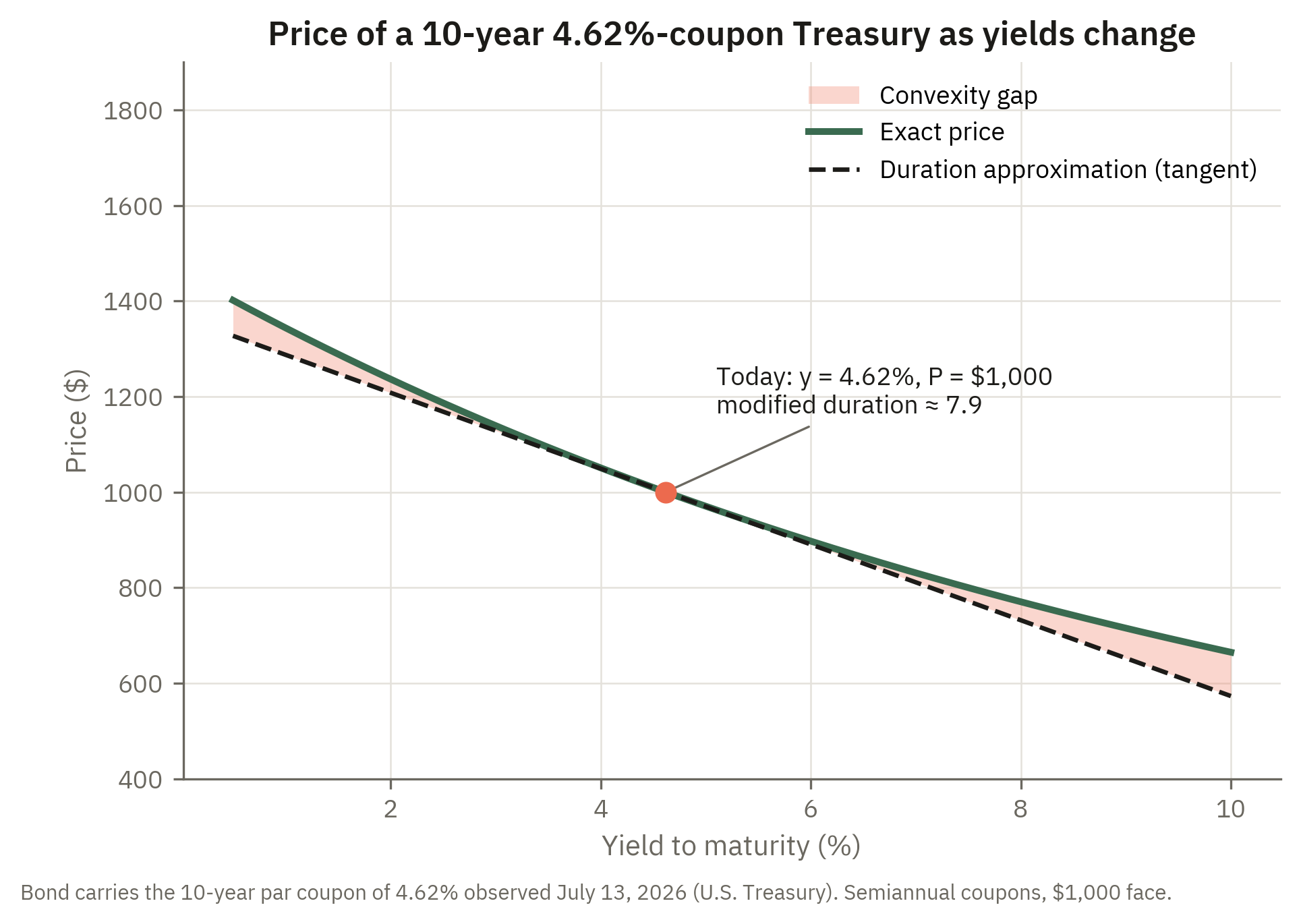
The economic content of modified duration is easiest to see in a picture. The pricing equation makes price a convex, decreasing function of yield, and the duration approximation \(\Delta P/P \approx -D^{*} \Delta y\) is precisely the tangent line to that curve at the current yield. Figure 11.1 draws both for a ten-year Treasury carrying today’s par coupon. Near the current yield the tangent hugs the curve and the approximation is excellent; far from it, the true price curve bends away above the tangent on both sides. That gap is no accident — the price curve is convex — and measuring it is the subject of the convexity section later in this chapter.
11.3 Duration's properties
The duration of a zero coupon bond is its time to maturity. To see this notice that the formula above gives
\[D = \frac{1}{P} \frac{TM}{(1 + y)^T} = \frac{(1 + y)^T}{M}\frac{TM}{(1 + y)^T} = T\]
Duration decreases in the coupon rate. Increasing the coupon rate moves more of the payments from the bond forward in time. As such it also makes the price of the bond less susceptible to changes in yield.
Duration often increases with the maturity of bonds. For most bonds, increasing the maturity means spreading payments out over a longer period. However, this may not be true for some bonds selling at a very deep discount.
Market Insight
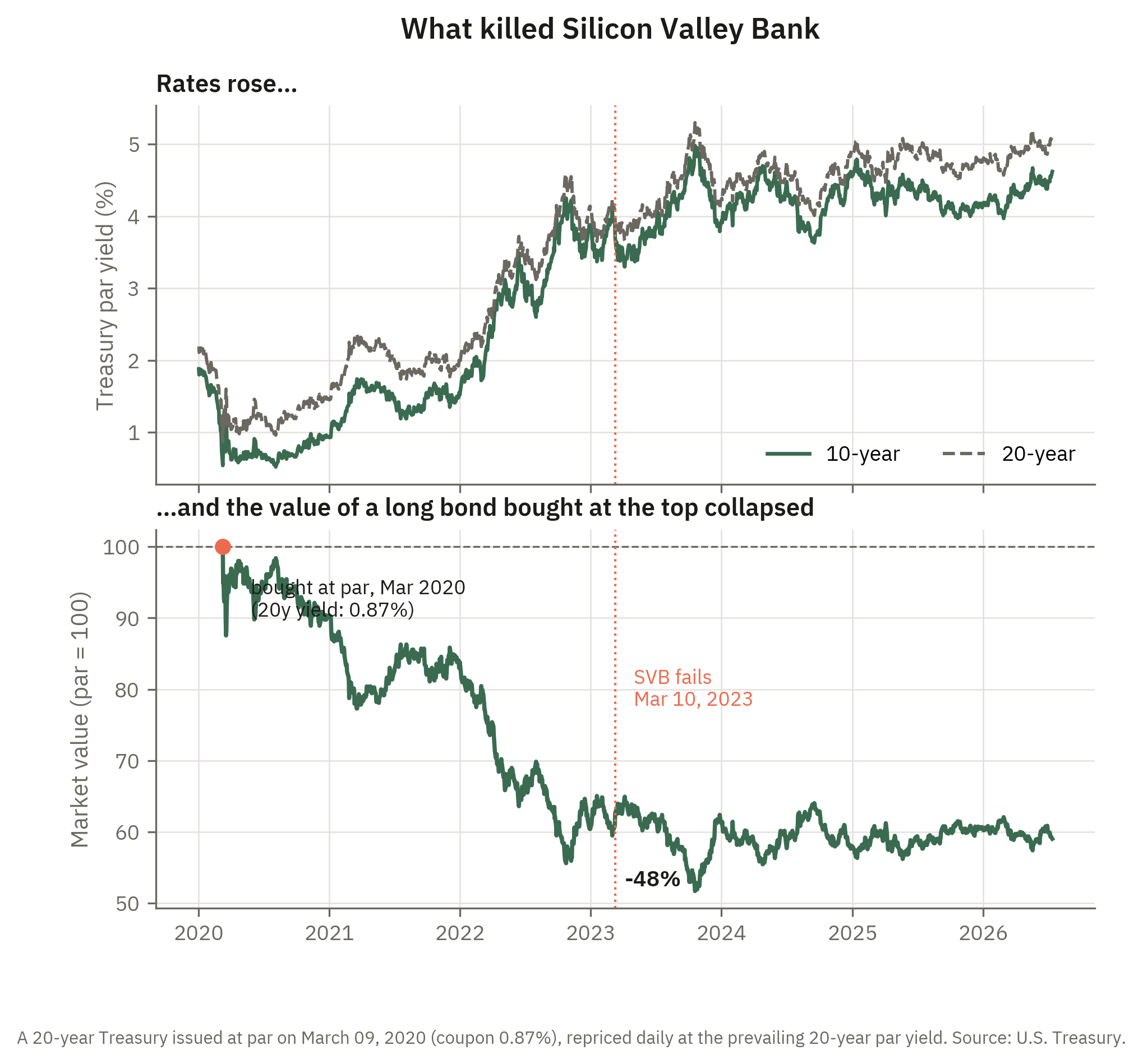
The duration arithmetic above is exactly what destroyed Silicon Valley Bank, and the numbers are worth working through. In March 2020 the 20-year Treasury yield touched 0.87%. A 20-year bond issued at par on that day has, by the formulas of this chapter, a modified duration of about eighteen. Between then and late 2023 long yields rose by roughly four percentage points, and the approximation \(\Delta P/P \approx -D^{*}\Delta y\) predicts a decline in value on the order of \(-18 \times 0.04 \approx -70\%\) — an overstatement, because for a move this large the convex price curve bends well above its tangent line, but the exact repricing in Figure 11.2 still shows a collapse of 48% at the trough. That is the mark-to-market hole that sat on SVB’s balance sheet in the spring of 2023: the bank held tens of billions of dollars of long-duration bonds bought when yields were near their lows, funded by deposits that could leave overnight. When depositors ran on March 9–10, 2023, the unrealized duration loss became a realized one. Note also what the figure does not show: no default, no credit event, no missed coupon. Every one of those Treasury payments will be made in full. Duration risk is a pure price-of-time risk, and it is entirely capable of sinking a bank on its own.
11.4 Portfolio Immunization
Knowledge about the duration of a particular payment stream gives a portfolio manager the ability to immunize her portfolio from the riskiness of yields. The strategy employed by such procedures is to purchase the rights to an obligation whose value changes exactly opposite to the change in value arising from a change in yield to the payment obligation.
- Example.
-
Consider a company that has agreed to pay an annuity of \(T\) annual payments with value \(M\) to an individual. If the current yield (discount rate) for such a payment stream is \(y\), then the value of such an annuity is
\[V = \frac{M}{y} \left ( 1 - \frac{1}{(1 + y)^T} \right )\]
The duration of this payment obligation is
\[D = \frac{1}{P} \sum_{t=1}^{T} \frac{tM}{(1 + y)^t}\]
The company wants to fund the annuity using a zero coupon bond and they want to simultaneously insulate themselves from changes in yield. To do so, they must choose the face value of the debt (F) that they will purchase and then choose the maturity (\(\tau\)) (i.e. choose the duration of the bond). The portfolio of obligations that the company will have after immunizing will be the fixed annuity payments and a single payment from the bond. The value of the portfolio of payment obligations is
\[V = - \frac{M}{y} \left ( 1 - \frac{1}{(1 + y)^T} \right ) + \frac{F}{(1 + y)^{\tau}}\]
This company will choose \(F\) and \(\tau\) such that \(V = 0\) and \(\partial V/ \partial y = 0\).
These two conditions pin down \(F\) and \(\tau\). Write the value of the obligation as \(P_{obl} = \frac{M}{y}\left(1 - (1+y)^{-T}\right)\) and the value of the zero as \(Z = F(1+y)^{-\tau}\), so that \(V = -P_{obl} + Z\). The first condition, \(V = 0\), requires \(Z = P_{obl}\): the zero must be purchased so that its present value equals the present value of the obligation.
For the second condition, differentiate. The zero satisfies \(\frac{\partial Z}{\partial (1+y)} = -\tau\,F(1+y)^{-\tau-1} = -\dfrac{\tau}{1+y}\,Z\), so its modified duration is \(\tau/(1+y)\) and its Macaulay duration is exactly its maturity \(\tau\). The obligation satisfies \(\frac{\partial P_{obl}}{\partial(1+y)} = -\dfrac{D_{obl}}{1+y}P_{obl}\), where \(D_{obl}\) is its Macaulay duration. Setting the derivative of \(V\) to zero,
\[\frac{\partial V}{\partial(1+y)} = \frac{D_{obl}}{1+y}P_{obl} - \frac{\tau}{1+y}Z = 0.\]
Because \(V = 0\) already forces \(Z = P_{obl}\), the common factor \(P_{obl}/(1+y)\) cancels and we are left with \(D_{obl} = \tau\). Duration-matching therefore forces the zero’s maturity \(\tau\) to equal the Macaulay duration of the obligation.
- Example.
-
Consider the previous example of a bond that matures in three years, makes annual coupon payments of 10% and currently sells at par ($1000). It was shown that the duration of the bond is 2.736. Consider the company choosing to meet the obligations of the bond by selling a zero coupon bond. So that the payment of the zero coupon bond has the same duration as the payment of the obligation. In order to hedge the obligation (which has a present value of $1000) the company purchases the zero in a quantity such that its present value is exactly $1000. The duration of the zero that they purchase should be \(\tau = 2.736\). Thus, \(F\) solves
\[\$ 1000 = \frac{F}{1.10^{2.736}}\]
which implies that \(F = \$1297.927\). Let's check that this works. Suppose that yields increase by a very small amount. What is the approximate change in the value of your portfolio?
\[\frac{\partial V}{\partial y} \frac{1 + y}{V} = - D + D = -2.736 + 2.736 = 0\]
Now suppose that yields on both the zero and the payment obligation increase by .0001 (1 basis point). What is the new value of the bond that you issued? It is given by
\[V_{B} = \frac{100}{1.1001} \left ( 1 - \frac{1}{(1.1001)^3} \right ) + \frac{1000}{1.1001^3} = \$999.751358\]
The value of the zero that you own is
\[V_{Z} = \frac{1297.927}{1.1001^3} = 999.751039\]
so the change in the value of your portfolio from a 1 basis point change in yields is \(-999.751358 + 999.751039 = -\$0.000319\). So your portfolio is largely immunized from small changes in yields.
Notice however that duration is an (first order) approximation of the change in the value of your portfolio as yields change. This approximation gets worse as the changes in yields get higher. To see this consider the following.
- Example cont'd.
-
Now suppose that instead of a 1 basis point change in yields you have a 50 basis point change in yields. Then the value of your portfolio becomes
\[\begin{aligned} V & = -\frac{100}{1.105} \left ( 1 - \frac{1}{(1.105)^3} \right ) + \frac{1000}{1.105^3} + \frac{1297.927}{1.105^3} \\ &= -987.67438 + 987.668207 \\ &= - .0061723 \end{aligned}\]
What if there were a 200 basis point change in yields?
\[\begin{aligned} \begin{aligned} V &= -\frac{100}{1.12} \left ( 1 - \frac{1}{(1.12)^3} \right ) + \frac{1000}{1.12^3} + \frac{1297.927}{1.12^3} \\ &= -951.96337 + 951.896559 \\ &= -0.066811 \end{aligned} \end{aligned}\]
So the approximation gets worse as changes in yield get larger. Why is this so?
11.5 Convexity
Recall that the change in the value of the bond portfolio was approximately the modified duration multiplied by the change in yield in the same sense that a finite change in the argument of a function leads to a change in the value of the function that is approximately the derivative of the function multiplied by the change in the argument. We can also do a second order Taylor series approximation of the price of the bond as a function of yield. To find the second derivative, differentiate the first derivative \(\frac{\partial P}{\partial(1+y)} = -\sum_{t=1}^{T} t\,CF_t (1+y)^{-t-1}\) once more with respect to \((1+y)\). Applying the power rule to \((1+y)^{-t-1}\) gives \(-(t+1)(1+y)^{-t-2}\), so each term’s two negative signs combine to a positive:
\[\frac{\partial^2 P}{\partial (1+y)^2} = -\sum_{t=1}^{T} t\,CF_t\cdot\left(-(t+1)\right)(1+y)^{-t-2} = \sum_{t=1}^{T} \frac{t(t+1)CF_t}{(1+y)^{t+2}}.\]
Because \(y\) and \(1+y\) differ by a constant, \(\partial/\partial y = \partial/\partial(1+y)\), and the second derivative of the price of a bond as a function of yield is
\[\frac{\partial^2 P}{\partial y^2} = \sum_{t=1}^T \frac{t(t+1)CF_{t}}{(1 + y)^{t+2}}\]
which is positive, confirming that the price-yield curve is convex.
Notice that bond price as a function of yield is convex for standard bonds. As such, we have the following definition.
- Convexity.
-
The second derivative of the bond price with respect to yield expressed as a fraction of the bond price.
\[Convexity(P(y)) = \frac{1}{P(1 + y)^2} \sum_{t=1}^{T} \frac{t(t + 1)CF_t}{(1 + y)^t}\]
In general, convexity is seen as a desirable property. Notice that since bonds are convex in yields, if yields go up the decrease in price that occurs will be much smaller than the increase in price that would occur if yields go down.
- Example.
-
Suppose that you have a payment obligation of $b a year for each of the next \(T\) years. You are concerned that the value of this obligation will increase (i.e. you are concerned that yields will decrease.) You want to provide a hedge against this occurence by purchasing assets with the money that you receive from selling the obligation. The present value of the payment obligation is
\[V = \sum_{t=1}^{T} \frac{b}{(1 + y)^t}\]
and the modified duration is
\[D = \frac{b}{P(1+y)} \sum_{t=1}^{T} \frac{1}{(1 + y)^t}\]
You want to purchase two different zero coupon bonds (of possibly different maturities) that have the same present value, modified duration and convexity when taken together as a portfolio. Notice that the convexity of a zero coupon bond is given by
\[\begin{aligned} Convexity \left( \frac{M}{(1 + y)^T} \right) = & \frac{1}{P} \frac{T(T+1)M}{(1 + y)^{T+1}} \\ & = \frac{(1 + y)^T}{M} \frac{T(T+1)M}{(1 + y)^{T+1}} \\ & = \frac{T(T+1)}{(1 + y)^2} \end{aligned}\]
The (Macaulay) duration of your obligation is given by \(D\) and the convexity is given by \(C\). Let \(p_1\) and \(p_2\) denote the present values (the dollar amounts) invested in the two zeros, with weights \(w_i = p_i/V\), so that \(p_1 + p_2 = V\) and \(w_1 + w_2 = 1\). Because each zero has Macaulay duration equal to its maturity \(\tau_i\) and convexity \(\tau_i(\tau_i+1)/(1+y)^2\), and the duration and convexity of a portfolio are the present-value-weighted averages of the components’, you must select \(p_1, p_2, \tau_1, \tau_2\) such that
\[\begin{aligned} V & = \frac{M_1}{(1 + y)^{\tau_1}} + \frac{M_2}{(1 + y)^{\tau_2}} = p_1 + p_2 \\ D & = w_1 \tau_1 + w_2 \tau_2 \\ C(1+y)^2 & = w_1\,\tau_1(\tau_1 + 1) + w_2\,\tau_2(\tau_2 + 1) \end{aligned}\]
where \(M_i = p_i(1+y)^{\tau_i}\) is the face value of zero \(i\). Note that matching the Macaulay duration \(D\) is equivalent to matching the modified duration \(D^* = D/(1+y)\), since both the obligation and the hedge portfolio are discounted at the same yield, so the common factor \(1/(1+y)\) cancels from both sides.
- Example.
-
Consider the previous example in which the obligation is the three-year 10% par bond (\(\$1000\) face, annual coupons of \(\$100\), and the \(\$1000\) principal repaid at maturity), currently selling at par. Its duration was \(2.736\). The convexity of this bond is
\[\begin{aligned} Convexity & = \frac{1}{1000(1.1)^2} \\ & \quad\times \left (\frac{1(1+1)100}{1.1^1} + \frac{2(2+1)100}{1.1^2} + \frac{3(3 + 1)1100}{(1.1)^3} \right ) \\ & = \frac{10595.04}{1210} = 8.7562 \end{aligned}\]
(The final cash flow is \(\$1100\) — the last coupon plus the \(\$1000\) principal — not \(\$100\); including the principal is what makes the third term dominate.) To keep the algebra clean, suppose we split the hedge equally between the two zeros, so \(w_1 = w_2 = \tfrac{1}{2}\) (each zero has present value \(\$500\)). The second and third matching conditions from the general example then become
\[\begin{aligned} 2.736 & = \tfrac{1}{2}\tau_1 + \tfrac{1}{2}\tau_2 \quad\Longrightarrow\quad \tau_1 + \tau_2 = 5.472, \mbox{ and} \\ 8.7562\,(1.1^2) & = \tfrac{1}{2}\tau_1(\tau_1+1) + \tfrac{1}{2}\tau_2(\tau_2+1) \\ &\Longrightarrow\quad \tau_1^2 + \tau_2^2 + \tau_1 + \tau_2 = 21.190. \end{aligned}\]
Substituting \(\tau_1 + \tau_2 = 5.472\) into the second equation gives \(\tau_1^2 + \tau_2^2 = 21.190 - 5.472 = 15.718\). Combined with the identity \((\tau_1+\tau_2)^2 = \tau_1^2 + \tau_2^2 + 2\tau_1\tau_2\), this yields
\[2\tau_1\tau_2 = 5.472^2 - 15.718 = 29.943 - 15.718 = 14.225, \qquad \tau_1\tau_2 = 7.113.\]
So \(\tau_1\) and \(\tau_2\) are the two roots of \(z^2 - 5.472\,z + 7.113 = 0\):
\[\tau = \frac{5.472 \pm \sqrt{5.472^2 - 4(7.113)}}{2} = \frac{5.472 \pm \sqrt{1.505}}{2} = \frac{5.472 \pm 1.227}{2},\]
giving \(\tau_1 = 2.12\) years and \(\tau_2 = 3.35\) years. Purchasing \(\$500\) of a \(2.12\)-year zero and \(\$500\) of a \(3.35\)-year zero matches the obligation’s present value, duration, and convexity, so the hedge remains accurate even for sizeable yield moves.
11.6 Application: A pension manager immunizing liabilities
A manager of a defined-benefit pension fund has promised a stream of payments to retirees stretching decades into the future, and must invest today’s assets so those promises are met whatever happens to interest rates. Duration and convexity are the instruments that make this possible. By measuring the duration of both the liabilities and the bond portfolio, the manager can match them so that a rise or fall in rates moves the value of assets and obligations together, immunizing the plan against the very shocks that would otherwise open a funding gap. The same arithmetic that quantifies how much a long bond falls when yields rise — the mechanism behind well-publicized bank failures — is, in the manager’s hands, the tool that keeps a pension solvent.
The Indicator from Planet Money (NPR) — “How Silicon Valley Bank became the largest bank failure since 2008”: how an unhedged duration mismatch — the exact risk this chapter manages — brought down a major bank.
11.7 Homework problems
11.7.1 Conceptual
FIP-C1. Two bonds have the same maturity and yield to maturity \(y\), but bond A pays a 3% annual coupon while bond B pays a 9% annual coupon. Using property 2 of duration, explain why bond A has the larger Macaulay duration \(D\), and state which of the two bonds will lose a larger percentage of its value when yields rise by a small amount \(\Delta y\).
FIP-C2. The chapter interprets Macaulay duration as the “center of gravity” of a bond’s payment stream — the time-weighted average of the present values of its cash flows. Using the formula \(D = \frac{1}{P}\sum_{t=1}^{T} \frac{t\,CF_t}{(1+y)^t}\), explain why raising the yield \(y\) (holding the cash flows fixed) lowers the Macaulay duration. Which cash flows lose the most weight in the average when \(y\) rises, and why does that pull the center of gravity toward the present?
FIP-C3. A colleague argues that a 30-year zero coupon bond and a 30-year coupon bond selling at par are equally risky because “they mature at the same time.” Using the definition of modified duration \(D^*\) as a measure of interest-rate sensitivity, and the chapter’s result that a zero’s Macaulay duration equals its maturity \(T\), explain why the two bonds do not have the same sensitivity to a change in yield. Which one would you expect to fall more in price for a given increase in \(y\)?
FIP-C4. The chapter states that “long-maturity, low-coupon bonds are far more sensitive to rate changes than short-maturity, high-coupon bonds.” Using the relation \(\frac{\Delta P}{P} \approx -D^* \Delta y\) together with the qualitative properties of duration, explain why both the maturity effect and the coupon effect push in the same direction here, and why \(D^*\) is the single number that lets a manager compare and aggregate this sensitivity across an entire portfolio.
FIP-C5. State property 2 of duration (“duration decreases in the coupon rate”) and explain the mechanism in terms of when, on average, the bondholder receives value. A perpetuity paying a fixed coupon forever and a zero coupon bond have very different duration behavior as the coupon rate changes — which of these two has a duration that does not depend on maturity at all, and how does that connect to property 2?
FIP-C6. Property 3 says duration “often increases with the maturity of bonds,” but the chapter warns this “may not be true for some bonds selling at a very deep discount.” Explain intuitively why lengthening maturity usually raises duration (in terms of spreading payments further into the future), and describe qualitatively why a deep-discount bond can break the pattern.
FIP-C7. A pension fund holds long-maturity Treasury bonds as assets and owes a stream of retiree payments as liabilities. Explain what it means to say the fund’s assets and liabilities are “duration-matched,” and describe what happens to the fund’s net position after a small parallel rise in yields if (a) asset duration equals liability duration, versus (b) asset duration is much shorter than liability duration. Connect part (b) to the Silicon Valley Bank episode described in the chapter.
FIP-C8. In the immunization example the company chooses the face value \(F\) and maturity \(\tau\) of a zero to satisfy \(V = 0\) and \(\partial V/\partial y = 0\). Explain in words what each of these two conditions guarantees, and show why together they force the zero’s maturity to equal the Macaulay duration of the obligation (\(\tau = D_{obl}\)). Why is it the Macaulay duration of the obligation, and not its maturity \(T\), that determines \(\tau\)?
FIP-C9. The chapter shows that a duration-matched portfolio still shows a small residual loss for a 50-basis-point move and a larger one for a 200-basis-point move. Explain, in terms of the second derivative \(\partial^2 P/\partial y^2\) and the curvature of the price-yield relationship, why a duration-only measure understates the true price for large yield moves. Why is the sign of the approximation error the same whether yields rise or fall?
FIP-C10. A bond fund manager says, “Given a choice between two bonds with identical duration, I will always take the one with higher convexity, and I would even pay a slightly higher price for it.” Using the chapter’s statement that a more convex bond “gains more when yields fall and loses less when yields rise,” explain why convexity is a desirable property and why it commands a price premium.
FIP-C11. In the chapter’s convexity-hedging example, the manager hedges a coupon obligation by buying two zero coupon bonds rather than one. Explain why one zero is not enough: how many conditions (present value, duration, convexity) must the hedge satisfy, and how many free choices does a single zero versus two zeros provide? Relate your count to the fact that in the worked example the two required conditions on maturities were \(\tau_1 + \tau_2 = 5.472\) and a second equation in \(\tau_1(\tau_1+1) + \tau_2(\tau_2+1)\).
FIP-C12. The barbell example matches present value, duration, and convexity using present-value weights \(w_i = p_i / V\). Explain why the duration and convexity of the two-bond portfolio are the present-value-weighted averages of the individual zeros’ durations and convexities (rather than, say, face-value-weighted averages). Why does matching Macaulay duration \(D\) automatically match modified duration \(D^* = D/(1+y)\) here, so that only one duration condition is needed?
11.7.2 Quantitative
FIP-Q1. A bond makes annual coupon payments of $60 (a 6% coupon on $1000 face) and matures in 3 years. Its YTM is \(y = 0.06\), so it sells at par (\(P = 1000\)). Compute its Macaulay duration \(D\) using \(D = \frac{1}{P}\sum_{t=1}^{T} \frac{t\,CF_t}{(1+y)^t}\).
FIP-Q2. A bond makes annual coupon payments of $40 (a 4% coupon on $1000 face) and matures in 2 years, so its cash flows are $40 at \(t=1\) and $1040 at \(t=2\). Its YTM is \(y = 0.04\), so it sells at par (\(P = 1000\)). Compute its Macaulay duration \(D = \frac{1}{P}\sum_{t=1}^{T} \frac{t\,CF_t}{(1+y)^t}\).
FIP-Q3. A zero coupon bond has face value \(M = 5000\), maturity \(T = 8\) years, and YTM \(y = 0.05\). Using the chapter’s result that a zero’s Macaulay duration equals its maturity, state \(D\), and then compute its modified duration \(D^* = D/(1+y)\).
FIP-Q4. A coupon bond has Macaulay duration \(D = 2.833\) and YTM \(y = 0.06\). Compute its modified duration \(D^* = D/(1+y)\), and state the economic meaning of the number: for a 1-percentage-point rise in yield, approximately what percentage of its value does the bond lose?
FIP-Q5. A bond portfolio has price \(P = 40{,}000\) and modified duration \(D^* = 7.2\). Using \(\frac{\Delta P}{P} = -D^* \Delta y\), compute the approximate percentage change and the approximate dollar change in the portfolio’s value if yields rise by 40 basis points (\(\Delta y = 0.0040\)).
FIP-Q6. A bond portfolio has price \(P = 25{,}000\) and modified duration \(D^* = 6.5\). Using \(\frac{\Delta P}{P} = -D^* \Delta y\), compute the approximate percentage change and the approximate dollar change in the portfolio’s value if yields fall by 25 basis points (\(\Delta y = -0.0025\)).
FIP-Q7. A liability has present value \(V = 250{,}000\) and modified duration \(D^* = 11\). A manager wishes to immunize it with a single zero coupon bond of the same present value. Using \(\frac{\Delta P}{P} = -D^*\Delta y\), what must the zero’s modified duration be for the net position to be first-order immune to small yield changes, and (with \(y = 0.04\)) what is the required maturity \(\tau\) of the zero (recall a zero’s \(D^* = \tau/(1+y)\))?
FIP-Q8. A company owes an annuity of \(M = 200\) per year for \(T = 4\) years, discounted at \(y = 0.05\). Its present value is \(V = \frac{M}{y}\left(1 - \frac{1}{(1+y)^T}\right)\). Compute \(V\). Then it funds the annuity with a zero coupon bond whose present value equals \(V\) and whose maturity is \(\tau = 2.5\). Compute the required face value \(F\) from \(V = \frac{F}{(1+y)^{\tau}}\).
FIP-Q9. A 2-year bond pays an annual coupon of $50 (5% on $1000 face) and matures at $1050 in year 2. Its YTM is \(y = 0.05\) so \(P = 1000\). Compute its convexity using \(Convexity = \frac{1}{P(1+y)^2}\sum_{t=1}^{T}\frac{t(t+1)CF_t}{(1+y)^t}\).
FIP-Q10. A zero coupon bond has maturity \(T = 3\) years and YTM \(y = 0.05\). Using the chapter’s closed form for the convexity of a zero, \(Convexity = \frac{T(T+1)}{(1+y)^2}\), compute its convexity. (Confirm you get the same answer as evaluating the general convexity formula on a single cash flow at \(t = 3\).)
FIP-Q11. Using the bond from FIP-Q9 (\(P = 1000\), \(D^* = D/(1+y)\) with \(D\) its Macaulay duration, and convexity \(C\) from FIP-Q9), estimate the change in price for a large yield increase of \(\Delta y = 0.02\) using the second-order approximation \(\Delta P \approx -D^* P \,\Delta y + \tfrac{1}{2} C P (\Delta y)^2\). (Take \(D = 1.9524\) for this bond.)
FIP-Q12. For the same bond as FIP-Q11 (\(P = 1000\), \(D = 1.9524\), \(y = 0.05\), convexity \(C = 5.2694\)), estimate the change in price for a large yield decrease of \(\Delta y = -0.03\) using \(\Delta P \approx -D^* P \,\Delta y + \tfrac{1}{2} C P (\Delta y)^2\). Comment on how the convexity term affects the estimate relative to the duration-only prediction.
11.7.3 Data exercises
These problems use the live-data figures in this chapter.
FIP-D1. Figure 11.1 shows a 10-year Treasury carrying the par coupon \(4.62\%\) (semiannual payments, \(\$1{,}000\) face), so it is priced at par with modified duration \(D^{*} \approx 7.9\). (a) Use the duration approximation to estimate the percentage price change if the yield rises by 100 basis points to \(5.62\%\). (b) Compute the exact new price from the pricing equation and the exact percentage change. (c) The two answers differ; state which is more negative, and connect the sign of the difference to the shaded region in the figure.
FIP-D2. In Figure 11.2, a 20-year Treasury issued at par in March 2020 with a \(0.87\%\) coupon had modified duration of roughly \(17\) at issue. Between March 2020 and October 2023 the 20-year yield rose by about \(4.2\) percentage points. (a) What loss does the first-order approximation \(\Delta P/P \approx -D^{*} \Delta y\) predict? (b) The figure shows the realized loss was about \(-48\%\). Give two reasons the linear prediction overstates the loss for a move this large. (c) Explain why this loss required no default by the U.S. Treasury.
Bodie, Kane and Marcus, pg. 517↩︎