4 Mean-Variance Portfolios
4.1 Introduction
Three questions motivate the study of mean-variance portfolio theory. First, given a risky asset and a risk-free asset, how should a rational investor divide her wealth between them, and how does the answer depend on her degree of risk aversion? Second, when multiple risky assets are available, how does the correlation structure among their returns shape the risk of the combined portfolio, and what role does diversification play? Third, across all possible ways of combining risky assets, which portfolios minimize risk for each level of expected return — and what does the answer imply about which risky portfolio every investor should hold regardless of her individual risk tolerance?
These questions are central to finance for both practical and theoretical reasons. Investors do not seek high returns in isolation; they seek high returns relative to the risk they must bear. Without a formal way to describe the feasible set of return-risk combinations and to find the combinations that are not dominated by any other, portfolio construction would rely on intuition rather than optimization. Moreover, the efficient frontier and the separation property derived in this chapter are the direct inputs to the Capital Asset Pricing Model, which translates the logic of optimal diversification into a theory of equilibrium asset prices.
The first question is addressed through the capital allocation line. When an investor can combine a single risky portfolio with a risk-free asset, the achievable mean-standard deviation combinations form a straight line whose slope — the Sharpe ratio — measures the reward per unit of risk. A mean-variance investor with risk aversion coefficient \(A\) optimally allocates a fraction of wealth to the risky asset equal to the risk premium divided by the product of risk aversion and portfolio variance. This formula makes precise the intuition that more risk-averse investors hold less of the risky asset and that assets with higher risk premia or lower variance attract greater demand.
The second question is answered by working out the variance of a portfolio of two or more risky assets. Portfolio variance depends not only on the individual asset variances and portfolio weights, but crucially on the covariances — or equivalently the correlations — between asset returns. When assets are not perfectly correlated, combining them reduces total portfolio variance below the weighted average of individual variances, a result known as diversification. An asset with negative correlation with the rest of the portfolio — a hedge asset — is especially valuable because it reduces portfolio risk while contributing positively to expected return in proportion to its own expected return. The degree of risk reduction available through diversification is therefore a function of the entire covariance matrix of asset returns.
The third question leads to the efficient frontier and the separation property. The chapter develops this by solving the variance-minimization problem formally with Lagrangian methods for the two-asset case; the general case of many assets, which uses matrix algebra to characterize the entire set of minimum-variance portfolios, is worked out in an appendix at the end of the chapter. The first-order conditions reveal that at any point on the efficient frontier, the ratio of excess expected return to covariance with the portfolio must be equal across all assets. When a risk-free asset is available, the efficient frontier collapses to a single ray: the capital allocation line constructed from the risk-free rate to the tangency portfolio on the risky-asset frontier. Because this tangency portfolio is the same for every investor regardless of risk aversion, all investors hold the same risky portfolio composition, differing only in how much of their wealth they allocate to it — a result known as the separation property.
Diversification is only as real as the covariances beneath it. By early 2026, the “Magnificent Seven” technology stocks had grown to roughly a third of the S&P 500 — so concentrated that a broad index fund, the textbook diversified portfolio, had quietly become a large bet on a handful of correlated names. Fortune argued there was “nowhere to hide.” This is the mean–variance problem in the headlines: how much true diversification does a portfolio actually provide once its holdings move together? Read it at Fortune.
4.2 Preferences
Consider an investor that has preferences that can be represented by the utility function \(U = Er - \frac{1}{2}A\sigma^2\). Indifference curves for this investor can be plotted with the expected return on the \(y\) axis and the standard deviation on the \(x\) axis. They slope upward and are convex.
4.3 Assets
The investor has available to her one risky and one risk-free asset. Looking forward we view the risky asset as a portfolio of assets that has been selected optimally. We will learn how to select this portfolio later. The (random) rate of return for the risky portfolio is \(r_P\). Its standard deviation is \(\sigma_P\). The rate of return on the risk free asset is \(r_f\). If the investor puts proportion \(y\) of her total available capital in the risky asset, after uncertainty has been resolved the investor will have \(W_0(1 + r_C) = W_{0}y(1 + r_P) + W_0(1-y)(1 + r_f)\). In terms of the state-preference model, if the risky asset costs \(p\) and the risk free asset costs \(p_f\), then total expenditures initially are \(x_P p + x_f p_f\). The value of the portfolio next period is \(x_P v_P + x_f v_f\). Algebra implies that \(r_C = w_P r_p + w_f r_f = y r_P + (1-y) r_f\). The expected value of this return is \(yEr_P + (1-y)r_f\). The variance of this portfolio is \(y^2 \sigma^2_P\) and the standard deviation is \(y \sigma_P\).
Suppose \(y = 0\). What is the expected return of the portfolio? Standard deviation? Now suppose that \(y = 1\). What are expected return and standard deviation? What about \(y = \frac{1}{2}\)?
One can think about increasing the expected return of the portfolio from \(r_f\) to \(Er_P\) by moving \(y\) from 0 to 1. As one does so, one must trade off increases in expected return with increases in the standard deviation of the complete portfolio.
Notice that the expected return of the complete portfolio as a function of its standard deviation is a straight line with intercept \(r_f\) and slope of
\[\frac{Er_P - r_f}{\sigma_P}\]
Why? The standard deviation of the portfolio is given by \(\sigma_C = y \sigma_P\). This implies that \(y = \frac{\sigma_C}{\sigma_P}\). Plugging this into the equation \(Er_C = y E r_P + (1-y) r_f = r_f + y( Er_P - r_f)\) yields
\[E r_C = r_f + \frac{\sigma_C}{\sigma_P}(Er_P - r_f)\]
showing that the set of possible complete portfolios implies a trade off between risk and return that has slope \(\frac{Er_P - r_f}{\sigma_P}\). This can be drawn in the \(\sigma, Er\) plane as an upward sloping line. The slope of this line represents the trade off that the market presents this investor between risk and return. This slope is also known as the Sharpe ratio. The line is called the capital allocation line (CAL).
4.4 The decision problem
From this the decision problem of the investor can be seen to be
\[\max Er_C - \frac{1}{2}A\sigma^2_C \mbox{ s.t. } E r_C = r_f + \frac{\sigma_C}{\sigma_P}(Er_P - r_f)\]
This can be solved by setting up the Lagrangian, or simply by substitution. Since \(Er_C = r_f + y(Er_P - r_f)\) and \(\sigma_C = y\sigma_P\) we can rewrite utility as
\[U = r_f + y(Er_P - r_f) - \frac{1}{2}Ay^2\sigma^2_P\]
The first order conditions with respect to \(y\) are
\[(Er_P - r_f) - yA\sigma^2_P = 0\]
which implies that the optimal amount to put into the risky asset is
\[y = \frac{Er_P - r_f}{A\sigma^2_P}\]
Notice that this increases ceteris paribus as the risk premium increases and as risk aversion or the variance of the portfolio decreases. So, investors that are more risk averse, will choose to be further to the left on the CAL whereas less risk averse investors will be more to the right.
4.5 Diversification
Where does the optimal risky portfolio come from? To understand this, we must understand the return/risk tradeoff for general portfolios. Consider a portfolio of two risky assets labelled \(D\) and \(E\). We have already seen that if the weight put on asset \(i\) in the portfolio is \(w_i\) then, the return to the whole portfolio will be \(r_P = w_D r_D + w_E r_E\). What is the variance of the portfolio?
\[\sigma^2_P = w^2_D \sigma^2_D + w^2_E \sigma^2_E + 2w_D w_E Cov(r_D,r_E)\]
Why? Write the variance as the expected squared deviation from the mean, \(\mu_P = w_D \mu_D + w_E \mu_E\), and group the deviation asset by asset:
\[\begin{aligned} \sigma^2_P &= E\left[ (w_D r_D + w_E r_E - w_D \mu_D - w_E \mu_E)^2 \right] \\ &= E\left[ \left( w_D(r_D - \mu_D) + w_E(r_E - \mu_E) \right)^2 \right] \\ &= E\left[ w^2_D(r_D-\mu_D)^2 + w^2_E(r_E-\mu_E)^2 + 2 w_D w_E (r_D-\mu_D)(r_E-\mu_E) \right] \\ &= w^2_D \sigma^2_D + w^2_E \sigma^2_E + 2 w_D w_E Cov(r_D,r_E), \end{aligned}\]
where the last line uses the definitions \(\sigma^2_i = E(r_i-\mu_i)^2\) and \(Cov(r_D,r_E) = E(r_D-\mu_D)(r_E-\mu_E)\). Recall also that if \(\rho_{DE}\) is the correlation coefficient of \(r_D\) and \(r_E\) then
\[\rho_{DE} = \frac{Cov(r_D,r_E)}{\sigma_D \sigma_E}.\]
This implies that the variance of the portfolio can be rewritten
\[\sigma^2_P = w^2_D \sigma^2_D + w^2_E \sigma^2_E + 2w_D w_E \sigma_D \sigma_E \rho_{DE}\]
Think about the case when \(\rho_{DE} = 1\). In that case the rhs of the above equation is a perfect square and simplifies to
\[\sigma^2_P = (w_D \sigma_D + w_E \sigma_E)^2\]
so the portfolio standard deviation is the weighted average of the two standard deviations, \(\sigma_P = w_D \sigma_D + w_E \sigma_E\) — diversification buys nothing. It can be seen that the portfolio variance is strictly decreasing in the correlation between assets. An asset is called a hedge if it has negative correlation with the other assets in the portfolio. The lowest possible portfolio variance is given by \(\rho_{DE} = -1\). In this case
\[\sigma^2_P = (w_D \sigma_D - w_E \sigma_E)^2\]
So one can eliminate all risk by taking \(w_D\) and \(w_E\) to make the above zero.
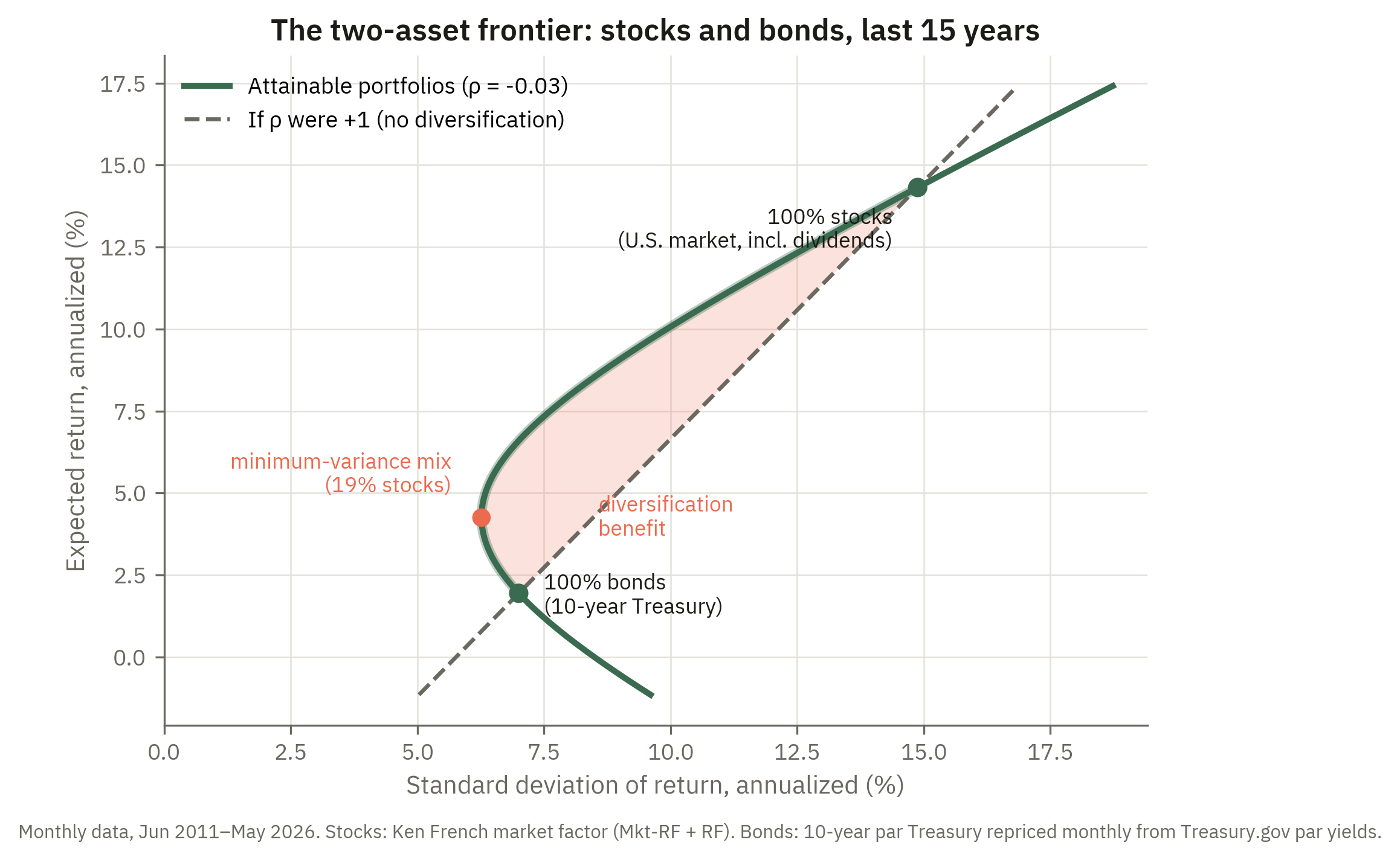
All of this algebra becomes a single picture when drawn with real assets. Figure 4.1 traces the mean and standard deviation of every portfolio of the U.S. stock market and a 10-year Treasury, using the last fifteen years of monthly returns. Over this sample the two assets are essentially uncorrelated (\(\rho = -0.03\)), and the dashed line shows the counterfactual just derived: if \(\rho\) were \(+1\), the frontier would collapse to the straight chord and portfolio risk would be the weighted average of the two standard deviations. The bow of the solid curve to the left of that chord is the diversification benefit, in units of standard deviation avoided. Note the point marked on the curve: the minimum-variance mix holds only about a fifth of the portfolio in stocks, yet carries less risk than a portfolio of bonds alone — an impossibility if risks simply added.
One interesting statistic to calculate is the covariance of any particular asset's returns to the return of the whole portfolio. We are interested in finding \(Cov(r_D,w_D r_D + w_E r_E )\) for example.
\[\begin{aligned} Cov(r_D, r_P) &= E(r_D - \mu_D)(w_D r_D + w_E r_E - w_D \mu_D - w_E \mu_E) \\ &= E(r_D - \mu_D)\left( w_D(r_D - \mu_D) + w_E(r_E - \mu_E) \right) \\ &= w_D E(r_D - \mu_D)^2 + w_E E(r_D - \mu_D)(r_E - \mu_E) \\ &= w_D Var(r_D) + w_E Cov(r_D,r_E). \end{aligned}\]
The second line simply collects the portfolio’s mean-deviation asset by asset, and the third distributes the factor \((r_D-\mu_D)\) across the two terms and takes expectations of each.
In general, for a portfolio with weights \(w_1,\ldots,w_n\) and return \(r_P = \sum_{i=1}^n w_i r_i\), the covariance of the return to asset \(j\) with the whole portfolio follows from the linearity of covariance:
\[Cov(r_j, r_P) = Cov\!\left(r_j, \sum_{i=1}^n w_i r_i\right) = \sum_{i=1}^n w_i\, Cov(r_i,r_j).\]
This is interesting because it means that the variance of the portfolio can be broken up into the covariance of each of the components of the portfolio with the whole portfolio: multiplying by \(w_j\) and summing over \(j\) gives \(\sum_j w_j Cov(r_j,r_P) = Cov(r_P,r_P) = \sigma^2_P\).
4.6 Minimum-variance portfolios
By changing the portfolio weights, one changes the variance and standard deviation of the portfolio. Since preferences depend only on the mean and standard deviation of returns, a natural question is: for each expected return, what is the lowest-variance portfolio one can obtain? This is the problem
\[\min Var(r_P) \mbox{ s.t. } Er_P \ge \bar r.\]
The set of solutions — one minimum-variance portfolio for each target expected return — traces out the efficient frontier. We solve this problem here for two risky assets; the general case of many assets, which uses matrix algebra, is developed in the appendix at the end of the chapter.
4.7 The two asset case
Consider the problem
\[\min \frac{1}{2} \left (w_D (w_D \sigma^2_D + w_E \sigma_{DE}) + w_E(w_E \sigma^2_E + w_D \sigma_{DE}) \right) \mbox{ s.t. } w'\mu \ge \bar r \mbox{ and } w' \mathbf{1} = 1\]
The first order conditions are
\[\begin{aligned} w_D\sigma^2_D + w_E \sigma_{DE} + \lambda \mu_D - \gamma & = 0 \\ w_E\sigma^2_E + w_D \sigma_{DE} + \lambda \mu_E - \gamma & = 0 \\ \end{aligned}\]
Recall that \(w_D \sigma^2_D + w_E \sigma_{DE}\) is the covariance of the asset \(D\) with the rest of the portfolio, which we have denoted \(\sigma_{DP}\). To interpret these first order conditions, divide the first one by \(\sigma_{DP}\) and the second one by \(\sigma_{EP}\) to obtain
\[\begin{aligned} 1 + \frac{\lambda \mu_D - \gamma}{\sigma_{DP}} & = 0 \\ 1 + \frac{\lambda \mu_E - \gamma}{\sigma_{EP}} & = 0 \\ \end{aligned}\]
Now define \(\theta = \gamma / \lambda\). Solving each first-order condition for the ratio \((\mu_i - \theta)/\sigma_{iP}\) gives \(-1/\lambda\) in both cases, so the two equations imply that
\[\frac{\mu_D -\theta}{Cov(r_D,r_P)} = \frac{\mu_E - \theta}{Cov(r_E,r_P)}.\]
Because this common ratio is the same for asset \(D\) and asset \(E\), it is also unchanged if we replace a single asset by any portfolio of the two. In particular, apply it to the risky portfolio \(P\) itself. Taking a weighted average of the numerators and denominators with weights \(w_D, w_E\) leaves the ratio equal to \((Er_P - \theta)/Cov(r_P,r_P)\), and since \(Cov(r_P,r_P) = \sigma^2_P\),
\[\frac{Er_i - \theta}{Cov(r_i,r_P)} = \frac{Er_P - \theta}{\sigma^2_P} \mbox{ for all } i.\]
Finally, identify \(\theta\). The quantity \(\theta\) is the expected return of an asset that has zero covariance with \(P\) (set \(Cov(r_i,r_P)=0\) above and the numerator must vanish, giving \(Er_i = \theta\)). When a risk-free asset is available it has exactly this property, so \(\theta = r_f\), yielding
\[\frac{Er_i - r_f}{Cov(r_i,r_P)} = \frac{Er_P - r_f}{\sigma^2_P} \mbox{ for all } i.\]
The same minimization can be carried out for an arbitrary number of risky assets using matrix algebra. That derivation traces out the full minimum-variance frontier, identifies the global minimum-variance portfolio, and establishes the two-fund separation result. Readers who are interested can find it in the appendix at the end of this chapter.
4.8 The capital allocation line (CAL)
Notice that for a given risk free rate \(r_f\), and a given efficient frontier, one may draw a capital allocation line as the highest line that passes through the risk free rate \(r_f\) and the efficient frontier. This will be the same for all investors as long as everyone agrees on the efficient frontier. This implies that the composition of the risky portfolio is independent of the risk aversion of the individual. This property is called separation.
4.9 Application: An advisor confronting concentration
A financial advisor sits across from a client who is delighted that her low-cost index fund has risen sharply, but who does not realize that a handful of correlated technology names now drive most of that fund’s movements. The advisor’s job is to translate that unease into numbers, and mean-variance analysis is the instrument. By estimating the covariances among the client’s holdings, the advisor can show how much of the portfolio’s risk is genuinely diversified away and how much is concentrated systematic exposure that a few disappointing earnings reports could expose. The efficient frontier then frames the conversation about whether to trim the position: it makes precise the gain in expected return per unit of risk the client is giving up — or buying — by tilting toward or away from the crowded trade.
Odd Lots (Bloomberg) — “Meb Faber on the Big Bear Market in Diversification and Tactical Allocation”: a practitioner’s take on why diversification works and how to spread risk across assets — the mean–variance problem in action.
4.10 Appendix: The general N-asset case
This appendix solves the minimum-variance problem for an arbitrary number of risky assets using matrix algebra.
Suppose that the assets are labelled \(1,\ldots,k\), all of which have different expected returns and variances. Let \(w\) be a vector of portfolio weights for each asset. Let the expected return vector for these assets be \(\mu\) and let \(\Sigma\) be the variance-covariance matrix of the assets. The expected portfolio return will be given by \(w'\mu\) and the variance will be \(w' \Sigma w\). The problem of interest is
\[\min w'\Sigma w \mbox{ s.t. } w'\mu \ge \bar r \mbox{ and } w' \mathbf{1} = 1\]
It is convenient to minimize \(\frac{1}{2} w' \Sigma w\) because it has the same solution, but more convenient expressions. The Lagrangian for this problem is
\[\mathcal{L} = \frac{1}{2} w'\Sigma w + \lambda(\bar r - w'\mu) + \gamma(1 - w' \textbf{1})\]
You know from 388 that the first order conditions to this problem are
\[\begin{aligned} \frac{1}{2}(\Sigma + \Sigma') w - \lambda \mu - \gamma \textbf{1} = 0 \\ \Sigma w = \lambda \mu + \gamma \textbf{1} \end{aligned}\]
Premultiplying both sides by \(\Sigma^{-1}\) gives
\[w = \lambda \Sigma^{-1}\mu + \gamma \Sigma^{-1} \textbf{1}\]
To eliminate the multipliers, premultiply the previous equation by \(\mu'\) and \(\textbf{1}\) to get
\[\begin{aligned} \mu' w = \lambda \mu' \Sigma^{-1}\mu + \gamma \mu' \Sigma^{-1} \textbf{1} \\ \textbf{1}' w = \lambda \textbf{1}' \Sigma^{-1}\mu + \gamma \textbf{1}' \Sigma^{-1} \textbf{1} \end{aligned}\]
The left-hand side of the first of these equations is the expected return to the portfolio and the left-hand side of the second is 1. Using the constraints \(\mu'w = \bar{r}\) and \(\mathbf{1}'w = 1\), the system becomes
\[\begin{aligned} \bar{r} &= \lambda \mu'\Sigma^{-1}\mu + \gamma \mu'\Sigma^{-1}\mathbf{1} \\ 1 &= \lambda \mathbf{1}'\Sigma^{-1}\mu + \gamma \mathbf{1}'\Sigma^{-1}\mathbf{1} \end{aligned}\]
It is convenient to introduce three scalar constants that depend only on the assets (not on the target return \(\bar{r}\)):
\[A = \mu'\Sigma^{-1}\mathbf{1} = \mathbf{1}'\Sigma^{-1}\mu, \qquad B = \mu'\Sigma^{-1}\mu, \qquad C = \mathbf{1}'\Sigma^{-1}\mathbf{1}, \qquad D = BC - A^2.\]
Note that \(\Sigma\) is a positive definite matrix (since it is a covariance matrix of non-redundant assets), which implies \(B > 0\), \(C > 0\), and by the Cauchy-Schwarz inequality \(D = BC - A^2 > 0\). The two-equation system can now be written compactly as
\[\begin{pmatrix} B & A \\ A & C \end{pmatrix} \begin{pmatrix} \lambda \\ \gamma \end{pmatrix} = \begin{pmatrix} \bar{r} \\ 1 \end{pmatrix}.\]
The determinant of the coefficient matrix is \(BC - A^2 = D > 0\), so the system has a unique solution. Applying Cramer’s rule gives
\[\lambda = \frac{C\bar{r} - A}{D}, \qquad \gamma = \frac{B - A\bar{r}}{D}.\]
Substituting these back into \(w = \lambda\Sigma^{-1}\mu + \gamma\Sigma^{-1}\mathbf{1}\) yields the optimal portfolio weights as an explicit function of the target return:
\[\boxed{w(\bar{r}) = \frac{C\bar{r} - A}{D}\,\Sigma^{-1}\mu + \frac{B - A\bar{r}}{D}\,\Sigma^{-1}\mathbf{1}.}\]
It is instructive to factor this as \(w(\bar{r}) = g + \bar{r}\,h\), where
\[g = \frac{B\,\Sigma^{-1}\mathbf{1} - A\,\Sigma^{-1}\mu}{D}, \qquad h = \frac{C\,\Sigma^{-1}\mu - A\,\Sigma^{-1}\mathbf{1}}{D}.\]
Both \(g\) and \(h\) are fixed vectors (independent of \(\bar{r}\)). This shows that every minimum-variance portfolio is a linear combination of the two fixed portfolios \(g\) and \(g + h\), which is the two-fund separation result: any point on the efficient frontier can be constructed by mixing two particular portfolios.
4.10.1 Portfolio variance on the frontier
From the first-order condition \(\Sigma w = \lambda\mu + \gamma\mathbf{1}\), premultiplying by \(w'\) gives
\[\sigma^2_P = w'\Sigma w = \lambda\,w'\mu + \gamma\,w'\mathbf{1} = \lambda\bar{r} + \gamma.\]
Substituting the expressions for \(\lambda\) and \(\gamma\):
\[\sigma^2_P = \frac{C\bar{r} - A}{D}\,\bar{r} + \frac{B - A\bar{r}}{D} = \frac{C\bar{r}^2 - 2A\bar{r} + B}{D}.\]
This is a parabola in the \((\bar{r},\,\sigma^2_P)\) plane, and equivalently a hyperbola in the \((\sigma_P,\,\bar{r})\) plane that is conventionally plotted with \(\sigma_P\) on the horizontal axis. The entire minimum-variance frontier is traced out as \(\bar{r}\) varies.
4.10.2 The global minimum-variance portfolio
The minimum of \(\sigma^2_P\) over all target returns is found by differentiating with respect to \(\bar{r}\) and setting the result to zero:
\[\frac{d\sigma^2_P}{d\bar{r}} = \frac{2C\bar{r} - 2A}{D} = 0 \implies \bar{r}^* = \frac{A}{C}.\]
Substituting back gives the minimum achievable variance:
\[\sigma^2_{min} = \frac{C(A/C)^2 - 2A(A/C) + B}{D} = \frac{B - A^2/C}{D} = \frac{BC - A^2}{CD} = \frac{1}{C}.\]
The weights of the global minimum-variance portfolio are obtained by setting \(\bar{r} = A/C\) in \(w(\bar{r})\):
\[w^* = \frac{C(A/C) - A}{D}\,\Sigma^{-1}\mu + \frac{B - A(A/C)}{D}\,\Sigma^{-1}\mathbf{1} = \frac{B - A^2/C}{D}\,\Sigma^{-1}\mathbf{1} = \frac{1}{C}\,\Sigma^{-1}\mathbf{1}.\]
Since \(C = \mathbf{1}'\Sigma^{-1}\mathbf{1}\), this simplifies to
\[\boxed{w^* = \frac{\Sigma^{-1}\mathbf{1}}{\mathbf{1}'\Sigma^{-1}\mathbf{1}}.}\]
The global minimum-variance portfolio weights are proportional to \(\Sigma^{-1}\mathbf{1}\), normalized so that they sum to one. The portfolio allocates more weight to assets that have low variance and low covariance with other assets, and is independent of expected returns entirely — it is determined solely by the covariance structure.
The efficient frontier is the upper half of this hyperbola: the set of minimum-variance portfolios with \(\bar{r} \ge A/C\). Portfolios on the lower half offer the same variance as a portfolio on the upper half but with a lower expected return and are therefore dominated.
4.11 Homework problems
4.11.1 Conceptual
MV-C1. Two investors, Ana and Ben, face the same risky portfolio (with return \(r_P\), standard deviation \(\sigma_P\)) and the same risk-free rate \(r_f\). Ana chooses to hold a complete portfolio with \(\sigma_C = 0.05\), while Ben holds one with \(\sigma_C = 0.15\). Using the geometry of the capital allocation line, explain who is more risk averse and why. Would the composition of the risky portion of their portfolios differ? Explain what this reveals about the CAL.
MV-C2. A new brokerage advertises that it can offer clients a “steeper” capital allocation line than its competitors while using the very same underlying risky portfolio. Given that the slope of the CAL is \(\frac{Er_P - r_f}{\sigma_P}\), explain what would have to be true for the brokerage’s claim to hold, and why an ordinary broker cannot simply make the CAL steeper at will. What does the slope represent economically?
MV-C3. An investor currently holds all her wealth in the risky portfolio (\(y = 1\)). The risk premium \(Er_P - r_f\) then doubles because the risk-free rate falls, while \(\sigma_P\) and her risk aversion \(A\) stay the same. Using the optimal allocation rule \(y = \frac{Er_P - r_f}{A\sigma^2_P}\), explain the direction in which she should adjust \(y\), and describe qualitatively how her position on the CAL moves. Would a very risk-averse investor and a nearly risk-neutral investor respond in the same direction?
MV-C4. Explain, in words, why the optimal risky fraction \(y = \frac{Er_P - r_f}{A\sigma^2_P}\) falls when the coefficient of risk aversion \(A\) rises but rises when the variance \(\sigma^2_P\) falls. Two investors face identical \(Er_P\), \(\sigma_P\), and \(r_f\) but one has twice the risk aversion of the other. Where does each end up on the CAL, and does the difference in \(A\) change which risky portfolio they hold?
MV-C5. Suppose two risky assets are being considered for a portfolio. Asset \(D\) has a slightly higher variance than asset \(E\), but \(D\) has strongly negative correlation with \(E\), whereas a third candidate asset \(F\) has the same variance as \(E\) but is positively correlated with it. Explain, using the role of covariance in portfolio variance, why the investor might prefer to add the higher-variance asset \(D\) rather than \(F\). What is the term for an asset like \(D\)?
MV-C6. Starting from \(\sigma^2_P = w^2_D\sigma^2_D + w^2_E\sigma^2_E + 2w_Dw_E\sigma_D\sigma_E\rho_{DE}\), explain what happens to portfolio variance as \(\rho_{DE}\) moves from \(+1\) down to \(-1\) with the weights and individual standard deviations held fixed. Why does \(\rho_{DE} = 1\) give a portfolio standard deviation equal to the weighted average of the individual standard deviations, while \(\rho_{DE} < 1\) gives strictly less? What does this reveal about the source of the diversification benefit?
MV-C7. A client protests that her index fund “is already diversified across 500 companies,” so correlation should not matter. Referring to the chapter’s decomposition \(\sigma^2_P = \sum_j w_j\,Cov(r_j, r_P)\) of portfolio variance into the covariance of each asset with the whole portfolio, explain why the number of holdings is not what determines diversification. Connect your answer to the chapter’s “In the news” observation about the Magnificent Seven.
MV-C8. Explain what the statistic \(Cov(r_j, r_P)\) measures and why it, rather than an asset’s own variance \(\sigma^2_j\), is the right notion of the “risk that asset \(j\) contributes” to a portfolio. Use the identity \(\sum_j w_j\,Cov(r_j, r_P) = \sigma^2_P\) to make the argument precise, and describe how an asset with low or negative \(Cov(r_j, r_P)\) affects total portfolio risk.
MV-C9. Consider the minimum-variance frontier traced by the problem \(\min Var(r_P)\) s.t. \(Er_P \ge \bar r\). An analyst identifies a portfolio that lies strictly inside the frontier (i.e., not on it). Explain in what sense this portfolio is “dominated,” and describe the two distinct improvements an investor could make by moving to the frontier. Why does no rational mean-variance investor hold an interior portfolio?
MV-C10. Two portfolios on the minimum-variance frontier have the same variance \(\sigma^2_P\) but different expected returns. Explain how this is possible given that the frontier is a parabola in the \((\bar r, \sigma^2_P)\) plane with vertex at \(\bar r^\ast = A/C\), and state which of the two a mean-variance investor would ever choose. What is the name for the acceptable (upper) half of the frontier?
MV-C11. The separation property says every investor holds the same risky portfolio regardless of risk aversion. A skeptic argues, “That can’t be right — surely a cautious retiree and an aggressive 25-year-old hold different things.” Reconcile the skeptic’s intuition with the separation result. Precisely where does the difference between the two investors show up, and where does it not?
MV-C12. In the appendix, every frontier portfolio is written as \(w(\bar r) = g + \bar r\, h\) for two fixed vectors \(g\) and \(h\). Explain how this algebraic fact establishes the two-fund separation result — that any frontier portfolio can be built by mixing just two fixed portfolios. When a risk-free asset is added, why does the relevant risky portfolio in the separation result become a single one (the tangency portfolio) common to all investors?
MV-C13. The global minimum-variance portfolio weights \(w^\ast = \frac{\Sigma^{-1}\mathbf{1}}{\mathbf{1}'\Sigma^{-1}\mathbf{1}}\) depend only on the covariance matrix \(\Sigma\) and not at all on expected returns \(\mu\). Explain intuitively why this is the case, and describe a practical situation in which an investor might deliberately choose to hold this portfolio despite giving up expected return.
MV-C14. Explain, using the structure of \(w^\ast = \frac{\Sigma^{-1}\mathbf{1}}{\mathbf{1}'\Sigma^{-1}\mathbf{1}}\), why the global minimum-variance portfolio tends to place more weight on assets with low variance and low covariance with the others. In practice, estimates of expected returns are far noisier than estimates of covariances; explain why this makes \(w^\ast\) attractive to some practitioners relative to a portfolio that also targets a particular expected return.
4.11.2 Quantitative
MV-Q1. A risky portfolio has \(Er_P = 0.11\) and \(\sigma_P = 0.20\), and the risk-free rate is \(r_f = 0.03\). (a) Write the equation of the capital allocation line, \(Er_C\) as a function of \(\sigma_C\). (b) What is the Sharpe ratio? (c) What expected return corresponds to a complete-portfolio standard deviation of \(\sigma_C = 0.08\)?
MV-Q2. Using the CAL \(Er_C = r_f + \frac{\sigma_C}{\sigma_P}(Er_P - r_f)\) with \(r_f = 0.02\), \(Er_P = 0.10\), and \(\sigma_P = 0.25\): (a) An investor targets an expected complete-portfolio return of \(Er_C = 0.06\). What standard deviation \(\sigma_C\) must she accept? (b) What fraction \(y\) of wealth is she holding in the risky portfolio? (Recall \(\sigma_C = y\sigma_P\).)
MV-Q3. An investor has risk aversion \(A = 4\), faces \(Er_P = 0.12\), \(\sigma_P = 0.20\), and \(r_f = 0.04\). (a) Compute the optimal fraction \(y\) in the risky portfolio using \(y = \frac{Er_P - r_f}{A\sigma^2_P}\). (b) What are the expected return and standard deviation of her complete portfolio? (c) If instead \(A = 2\), recompute \(y\) and comment on the change.
MV-Q4. Using \(y = \frac{Er_P - r_f}{A\sigma^2_P}\): an investor with \(A = 3\) currently sets \(y = 0.5\) when \(\sigma_P = 0.20\) and \(r_f = 0.03\). (a) What risk premium \(Er_P - r_f\) is implied? (b) Now suppose \(\sigma_P\) rises to \(0.25\) with the same risk premium and \(A\). Recompute \(y\) and explain the direction of the change.
MV-Q5. Two risky assets \(D\) and \(E\) have \(\sigma_D = 0.30\), \(\sigma_E = 0.20\), and correlation \(\rho_{DE} = 0.25\). The portfolio weights are \(w_D = 0.4\) and \(w_E = 0.6\). Using \(\sigma^2_P = w^2_D\sigma^2_D + w^2_E\sigma^2_E + 2w_Dw_E\sigma_D\sigma_E\rho_{DE}\), compute the portfolio variance and standard deviation. Compare the result to the weighted average of the two standard deviations and comment on the diversification benefit.
MV-Q6. Take assets \(D\) and \(E\) with \(\sigma_D = 0.40\), \(\sigma_E = 0.10\), and \(\rho_{DE} = -1\). Using the perfect-negative-correlation form \(\sigma^2_P = (w_D\sigma_D - w_E\sigma_E)^2\) together with \(w_D + w_E = 1\), find the weights \(w_D, w_E\) that make the portfolio risk-free (\(\sigma_P = 0\)). Verify your answer.
MV-Q7. For a three-asset problem, the frontier constants are \(A = \mu'\Sigma^{-1}\mathbf{1} = 2.0\), \(B = \mu'\Sigma^{-1}\mu = 0.30\), and \(C = \mathbf{1}'\Sigma^{-1}\mathbf{1} = 20\). (a) Compute \(D = BC - A^2\). (b) Using \(\sigma^2_P = \frac{C\bar r^2 - 2A\bar r + B}{D}\), find the minimum-variance portfolio’s variance at a target return of \(\bar r = 0.15\). (c) What is the expected return \(\bar r^\ast = A/C\) of the global minimum-variance portfolio, and what is its variance \(\sigma^2_{min} = 1/C\)?
MV-Q8. For a set of risky assets the frontier constants are \(A = 1.2\), \(B = 0.20\), and \(C = 8\). (a) Compute \(D\). (b) Using \(\sigma^2_P = \frac{C\bar r^2 - 2A\bar r + B}{D}\), compute the minimum-variance-frontier variance at target returns \(\bar r = 0.10\) and \(\bar r = 0.20\). (c) Verify that the smaller variance occurs at the return closer to \(\bar r^\ast = A/C\), and confirm that \(\sigma^2_P\) evaluated at \(\bar r^\ast\) equals \(1/C\).
MV-Q9. Consider two assets with covariance matrix \(\Sigma = \begin{pmatrix} 0.04 & 0.01 \\ 0.01 & 0.09 \end{pmatrix}\). Using the global minimum-variance weights \(w^\ast = \frac{\Sigma^{-1}\mathbf{1}}{\mathbf{1}'\Sigma^{-1}\mathbf{1}}\), compute the weights on the two assets and the resulting minimum variance \(1/C\). Comment on which asset receives more weight and why.
MV-Q10. Two uncorrelated assets have variances \(\sigma^2_1 = 0.01\) and \(\sigma^2_2 = 0.04\), so \(\Sigma = \begin{pmatrix} 0.01 & 0 \\ 0 & 0.04 \end{pmatrix}\). Using \(w^\ast = \frac{\Sigma^{-1}\mathbf{1}}{\mathbf{1}'\Sigma^{-1}\mathbf{1}}\), find the global minimum-variance weights and the minimum variance \(1/C\). Show that the weights are inversely proportional to the individual variances and explain why that makes sense.
4.11.3 Data exercises
These problems use the live-data figure in this chapter.
MV-D1. Figure 4.1 reports, for the last fifteen years of monthly data: stocks \(\mu_D = 14.3\%\), \(\sigma_D = 14.9\%\); 10-year Treasury \(\mu_E = 1.95\%\), \(\sigma_E = 7.0\%\); correlation \(\rho_{DE} = -0.03\) (all annualized). (a) Compute the mean and standard deviation of the 50/50 portfolio. (b) Compute what the 50/50 standard deviation would be if \(\rho_{DE}\) were \(+1\), and interpret the difference as the diversification benefit shown by the shaded region in the figure.
MV-D2. Using the same inputs as MV-D1 and the two-asset minimum-variance weight \(w_D^{*} = \dfrac{\sigma_E^2 - \sigma_D\sigma_E\rho_{DE}}{\sigma_D^2 + \sigma_E^2 - 2\sigma_D\sigma_E\rho_{DE}}\), compute the minimum-variance share in stocks and verify that it matches the mix marked in Figure 4.1. Then explain why the minimum-variance portfolio holds any stocks at all, given that stocks are twice as volatile as the bond.